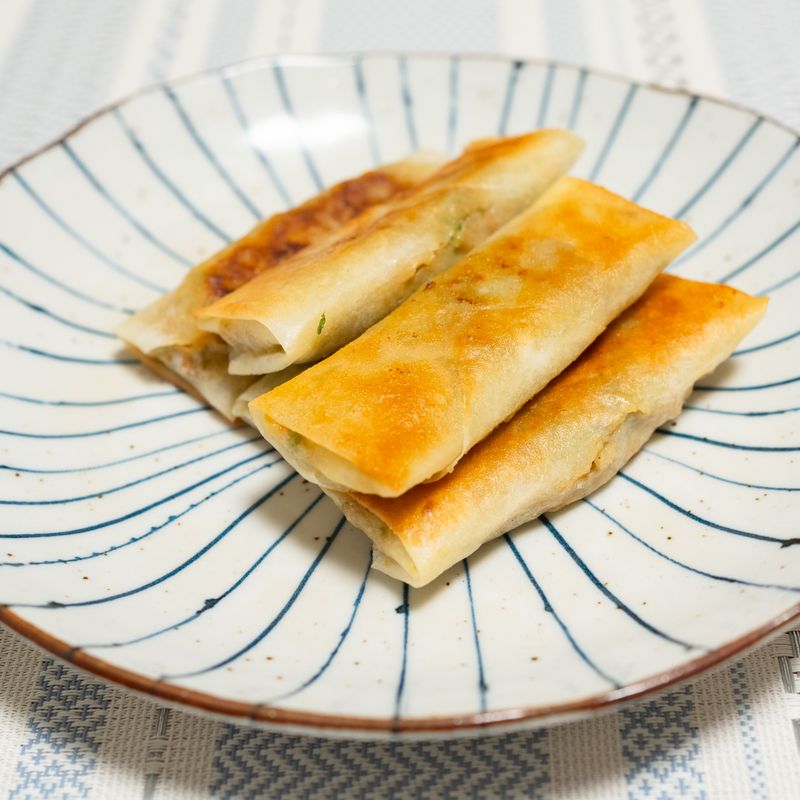
Classic Crispy Egg Rolls
Blistered, shatteringly crisp wrappers hold a savory filling of ground pork, cabbage, carrots, ginger and scallions. Cooling the filling before rolling and frying at a steady 350°F keeps them crunchy and never greasy.
- Prep
- 40 min
- Cook
- 40 min
- Wait
- 35 min
- Total
- 1 hr 55 min
- Makes
- 12 egg rolls (serves 6 as an appetizer, 2 each)
Steps
Before you start
- Read the whole recipe first: the filling must cool completely (about 30 minutes) before you roll, or steam will make the wrappers soggy and tear.
- Take the egg roll wrappers out of the fridge 15 minutes before rolling so they are pliable and don't crack. Keep them covered with a damp towel while you work.
- You need a deep-fry thermometer. Oil that is too cool makes greasy egg rolls; oil that is too hot browns the wrapper before the filling is hot.
- Set up a wire rack over a rimmed baking sheet for draining. Paper towels trap steam and soften the crust.
Prep the vegetables
- Shred the cabbage as thinly as you can with a knife or the shredding disc of a food processor, then chop any very long strands so they are no longer than 3 inches (7.5 cm).
- Grate the carrots on the large holes of a box grater.
- Mince the garlic, grate the ginger and slice the scallions.
- Keep the cabbage and carrots together in one bowl and the garlic, ginger and scallions together in another.
+ Show details− Hide details
Ready when: Cabbage shreds are thin and short enough to fold easily without poking through a wrapper.
Tip: Long, thick shreds are the main cause of torn wrappers, so take the time to cut them fine.
Brown the pork
- Heat the 1 tablespoon (15 ml) vegetable oil in a 12-inch (30 cm) skillet or wok over medium-high heat until it shimmers, about 1 minute.
- Add the ground pork and break it into small crumbles with a wooden spoon.
- Cook, stirring occasionally, for 6 to 8 minutes, until no pink remains, the juices have mostly evaporated and the edges are lightly browned.
+ Show details− Hide details
Ready when: No pink remains and the pan looks nearly dry; pork reaches 160°F (71°C).
Tip: If the pork releases a lot of liquid, keep cooking until the pan is almost dry. Excess moisture makes soggy egg rolls.
Cook the vegetables
- Push the pork to one side and add the garlic, ginger and scallions to the cleared space.
- Stir for 30 seconds until fragrant, then mix into the pork.
- Add the cabbage and carrots and stir-fry for 4 to 5 minutes, until the cabbage has wilted to about half its volume but still has a little crunch.
+ Show details− Hide details
Ready when: Cabbage is wilted and glossy but still slightly crisp; no puddles of liquid in the pan.
Tip: Don't cook the cabbage until soft; it keeps cooking in the hot egg roll.
Season and cool filling
- Remove the pan from the heat.
- Stir in the soy sauce, oyster sauce, sesame oil, sugar and white pepper.
- Tilt the pan and, if any liquid pools, drain it off or return to heat for 1 minute to evaporate it.
- Spread the filling in a thin layer on a rimmed baking sheet and let it cool to room temperature, about 30 minutes (or 10 minutes in the freezer).
+ Show details− Hide details
Ready when: Filling feels cool, not warm, when you touch it, and looks moist but not wet.
Tip: Warm filling steams the wrapper from inside and leads to blisters that turn soggy.
Set up the rolling station
- Whisk the cornstarch and cold water in a small bowl until smooth to make the sealing paste.
- Set out the cooled filling, the stack of wrappers under a damp towel, the paste with a pastry brush, and a lined tray or plate for finished rolls.
- Place one wrapper on the counter in a diamond orientation, with one corner pointing toward you.
+ Show details− Hide details
Ready when: Paste is smooth and milky, with no cornstarch lumps at the bottom of the bowl.
Tip: Re-whisk the paste before each use because cornstarch settles quickly.
Fill and roll
- Spoon about ⅓ cup (65 g) of filling onto the lower third of the wrapper, shaping it into a compact 4-inch (10 cm) horizontal log and leaving a 1-inch (2.5 cm) border.
- Fold the bottom corner up and over the filling, pulling it snug.
- Fold the left and right corners in toward the center like an envelope.
- Brush the top corner with paste, then roll up tightly away from you and press to seal.
- Repeat with the remaining wrappers, keeping finished rolls seam-side down and not touching.
+ Show details− Hide details
Ready when: Each roll is firm and tightly wrapped with no gaps, and the seam is sealed flat.
Tip: Roll snugly. Loose rolls trap air and oil and can burst when frying.
Heat the frying oil
- Pour the frying oil into a 5-quart (4.7 L) heavy, deep pot so it is about 2 inches (5 cm) deep, at least 3 inches (7.5 cm) below the rim.
- Clip a deep-fry thermometer to the side and heat over medium heat to 350°F (175°C), about 8 to 10 minutes.
- Set a wire rack over a baking sheet next to the stove.
+ Show details− Hide details
Ready when: Thermometer reads 350°F (175°C) and the oil is shimmering.
Tip: Never leave hot oil unattended, and keep a pot lid nearby to smother any flare-up.
Fry in batches
- Lower 3 egg rolls into the oil, seam-side down, one at a time, using tongs or a spider.
- Fry for 3 to 4 minutes, turning once or twice, until deep golden brown and blistered all over.
- Transfer to the wire rack.
- Let the oil return to 350°F (175°C) for about 1 minute between batches, adjusting the heat to hold 340–360°F (170–182°C).
- Repeat with remaining rolls (4 batches total).
+ Show details− Hide details
Ready when: Deep golden brown, bubbly-blistered wrappers and the bubbling around the rolls has slowed.
Tip: Don't crowd the pot. Too many cold rolls at once drops the oil temperature and makes them greasy.
Drain, rest and serve
- Let the egg rolls drain on the wire rack for 5 minutes so the crust sets and the filling cools slightly.
- Cut in half on the diagonal if you like and serve warm with your favorite dipping sauce, such as sweet and sour sauce, duck sauce or hot mustard.
+ Show details− Hide details
Ready when: Wrapper feels crisp and rigid when tapped.
Tip: Be careful with the first bite; the steam and filling are very hot.
Good to know
Tips
- Cool filling and tightly rolled wrappers are the two keys to crisp, non-greasy, non-bursting egg rolls.
- Keep unused wrappers under a damp towel at all times; exposed wrappers dry out and crack in minutes.
- Fry in small batches and monitor the thermometer, aiming to hold 340–360°F (170–182°C).
- To bake instead of frying, brush rolls with oil and bake at 425°F (220°C) for 18 to 22 minutes, turning once. They will be crunchy but less blistered.
Make ahead
Make the filling up to 2 days ahead and refrigerate it covered. Bring to cool room temperature, or use it cold, and drain off any liquid before rolling. Rolled, unfried egg rolls can be refrigerated on a parchment-lined tray, covered, for up to 8 hours, or frozen solid on a tray and then bagged for up to 2 months. Fry from frozen at 335°F (168°C) for 5 to 6 minutes.
Storage & reheating
Room temperature: up to 2 hours (food safety). Fridge: in an airtight container, up to 3 days. Freezer: cooled fried egg rolls up to 2 months. To reheat, place on a wire rack on a baking sheet in a 400°F (200°C) oven for 10 to 15 minutes (from the fridge) or 15 to 20 minutes (from the freezer), turning once, until crisp and hot throughout. Don't microwave.
Substitutions
- ground pork → ground chicken, ground turkey or finely chopped raw shrimp. Chicken and turkey are leaner, so add 1 extra teaspoon of oil. Cook poultry to 165°F (74°C). Shrimp should be stir-fried until just pink.
- oyster sauce → hoisin sauce. Slightly sweeter; reduce the sugar to ½ teaspoon. For a vegetarian version use mushroom 'oyster' sauce.
- green cabbage → packaged coleslaw mix (no dressing). A convenient shortcut; use about 5 cups (350 g) and chop the strands shorter.
- peanut or vegetable oil, for deep-frying → canola or sunflower oil. Any neutral oil with a smoke point above 400°F (205°C) works.
More finger food
See all →



Find more like this
- Meal
- Snack
- Cuisine
- Chinese
- Main ingredient
- Ground PorkCarrotsCabbage
- Diet
- Dairy-Free
- Method
- Stovetop