
Clam and Bacon Chowder
A rich, creamy chowder loaded with tender clams, smoky bacon, and tender potatoes. The briny clam juice combines with heavy cream and bacon fat to create a deeply satisfying soup that's perfect as a main course or starter.
- Prep
- 20 min
- Cook
- 40 min
- Wait
- 5 min
- Total
- 1 hr 5 min
- Makes
- 6 servings (about 8 cups)
Steps
Before you start
- Shuck fresh clams or have your fishmonger do it; reserve all clam juice
- Use a 5-quart heavy pot or Dutch oven
- Have cream and broth at room temperature to prevent curdling
Render bacon
- In the 5-quart pot, cook the chopped bacon over medium heat, stirring occasionally, until crispy and browned, about 8 minutes.
- The fat will render and coat the bottom of the pot.
- Transfer the bacon to a paper-towel-lined plate, leaving the bacon fat in the pot.
+ Show details− Hide details
Ready when: Bacon is crispy and golden brown
Tip: Don't discard the rendered bacon fat—it's essential for the chowder's flavor.
Sauté aromatics
- Add the diced onion and celery to the bacon fat in the pot.
- Cook, stirring frequently, until softened and lightly golden, about 5 minutes.
- Add the minced garlic and cook for 1 minute more, stirring constantly, until fragrant.
+ Show details− Hide details
Ready when: Onion and celery are translucent and beginning to caramelize; garlic is fragrant
Tip: Watch the garlic carefully so it doesn't burn and turn bitter.
Make roux
- Sprinkle the flour over the vegetables and stir constantly with a wooden spoon for 2 minutes.
- The mixture should look like wet sand.
- This roux will thicken the chowder.
- Cook on medium heat.
+ Show details− Hide details
Ready when: Flour is evenly distributed and coats the vegetables; no dry flour is visible
Tip: Stir constantly to prevent lumps from forming in the finished chowder.
Add liquids
- Pour in the clam juice and chicken broth, stirring constantly to break up any flour lumps.
- Add the thyme sprigs and bay leaf.
- Bring the mixture to a gentle simmer over medium-high heat, stirring occasionally.
+ Show details− Hide details
Ready when: Mixture reaches a gentle simmer with small bubbles breaking the surface
Tip: Stir well to incorporate the roux fully so you don't have lumpy spots in the final soup.
Add potatoes
- Stir in the diced potatoes.
- Reduce the heat to medium and simmer gently, stirring occasionally, until the potatoes are tender and easily pierced with a fork, about 12–15 minutes.
+ Show details− Hide details
Ready when: Potatoes are fork-tender and no longer firm
Tip: Don't let the broth boil hard or the potatoes will break apart. Maintain a gentle simmer.
Add clams
- Stir in the chopped clams and the reserved cooked bacon.
- Simmer for 2 minutes, stirring occasionally, just to warm the clams through.
- Do not boil, as boiling will toughen the clams.
+ Show details− Hide details
Ready when: Clams are warm and no longer cold from the roux
Tip: Add clams at the very end to keep them tender. Overcooked clams become rubbery.
Finish with cream
- Reduce the heat to medium-low.
- Pour in the heavy cream in a thin, steady stream while stirring gently and constantly.
- Continue stirring for about 2 minutes to ensure the cream is fully incorporated and heated through without curdling.
- The soup should be creamy and pale.
+ Show details− Hide details
Ready when: Cream is fully incorporated and soup has a pale, creamy appearance
Tip: Keep the heat low and stir gently to prevent the cream from breaking or curdling. Never let it boil once cream is added.
Season and serve
- Remove the thyme sprigs and bay leaf.
- Taste the chowder and adjust the seasoning with kosher salt and black pepper.
- Add a dash of hot sauce if desired.
- Ladle the chowder into bowls and serve immediately while hot.
+ Show details− Hide details
Ready when: Flavors are balanced and chowder has cooled slightly so it won't burn your mouth
Tip: Taste as you season—the clam juice and bacon are already salty, so add salt gradually to avoid over-seasoning.
Good to know
Tips
- If your chowder breaks or curdles, whisk together 1 tablespoon (8 g) cornstarch with 2 tablespoons (30 ml) cold water to make a slurry, then slowly whisk it in over low heat while stirring constantly. This will help smooth it out.
- For extra flavor, save the liquid from shucking the fresh clams and use it in place of some of the bottled clam juice in step 4. This adds briny depth.
- Serve the chowder with oyster crackers, crusty bread, or grilled cheese sandwiches on the side for a complete meal.
- If you prefer a thinner chowder, reduce the flour to 2 tablespoons (16 g) or add an extra 1 cup (240 ml) of broth.
Make ahead
You can prepare the chowder up through step 5 (after the potatoes are cooked) up to 1 day ahead. Cool, cover, and refrigerate. Reheat gently over medium-low heat, then add the clams, bacon, and cream as described in steps 6–7.
Storage & reheating
Refrigerator: Store in an airtight container for up to 3 days. Reheat gently over medium-low heat on the stovetop, stirring occasionally, until warmed through (do not boil). Freezer: The chowder can be frozen for up to 3 months if made without the cream; freeze after step 5. Thaw overnight in the refrigerator and reheat gently, then add fresh cream and clams. Freezing cream-based chowder is not recommended as the cream may separate upon thawing.
Substitutions
- littleneck clams, shucked → canned clams (two 6.5-ounce / 184 g cans, drained) or frozen clams. If using canned clams, reserve their liquid and add to the broth in step 4 instead of using all bottled clam juice. Canned and frozen clams require only 1 minute of warming in step 6.
- heavy cream → half-and-half or whole milk with 2 tablespoons (30 g) butter stirred in. Half-and-half creates a lighter texture; milk will be thinner and less rich, but still delicious.
- bacon strips → pancetta (3 ounces / 85 g, finely diced) or smoked salt (1 teaspoon / 6 g) stirred in at the end. Pancetta adds similar smoky flavor but is fattier; smoked salt is a quick substitute if you don't have bacon.
- russet potatoes, medium → red potatoes or fingerling potatoes (cut into ½-inch pieces). Waxy potatoes hold their shape better than russets, giving a chunkier, less starchy chowder.
More chowders
See all →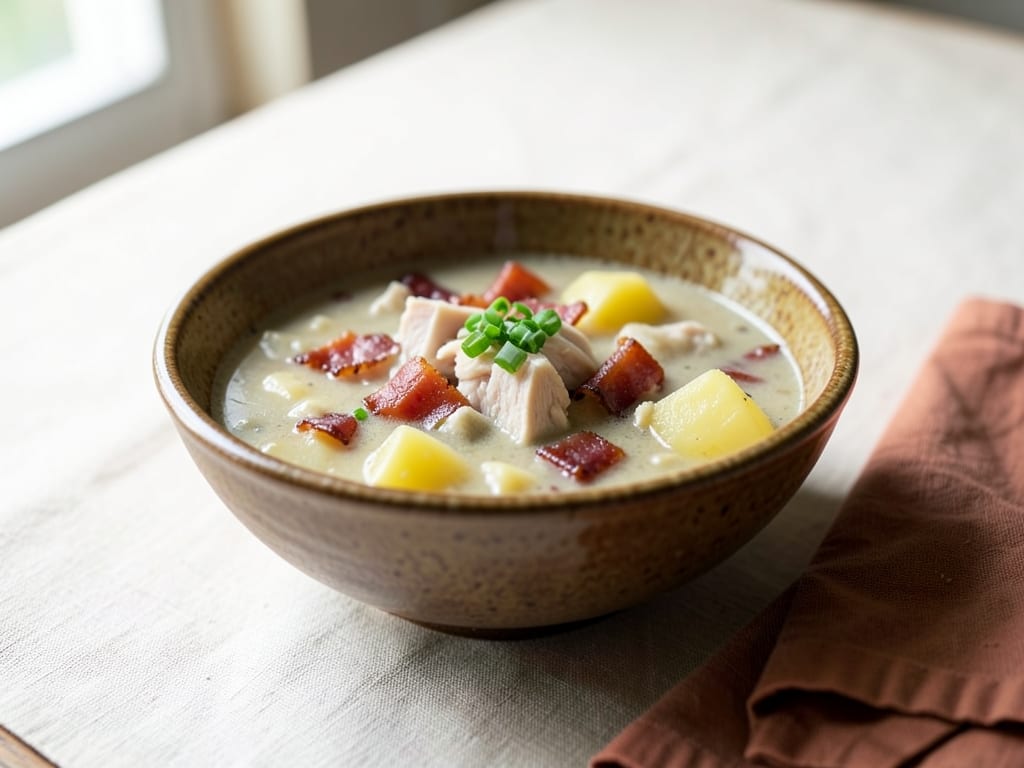
Find more like this
- Meal
- Lunch
- Cuisine
- American
- Main ingredient
- Bacon
- Diet
- Sugar-Free
- Method
- Stovetop