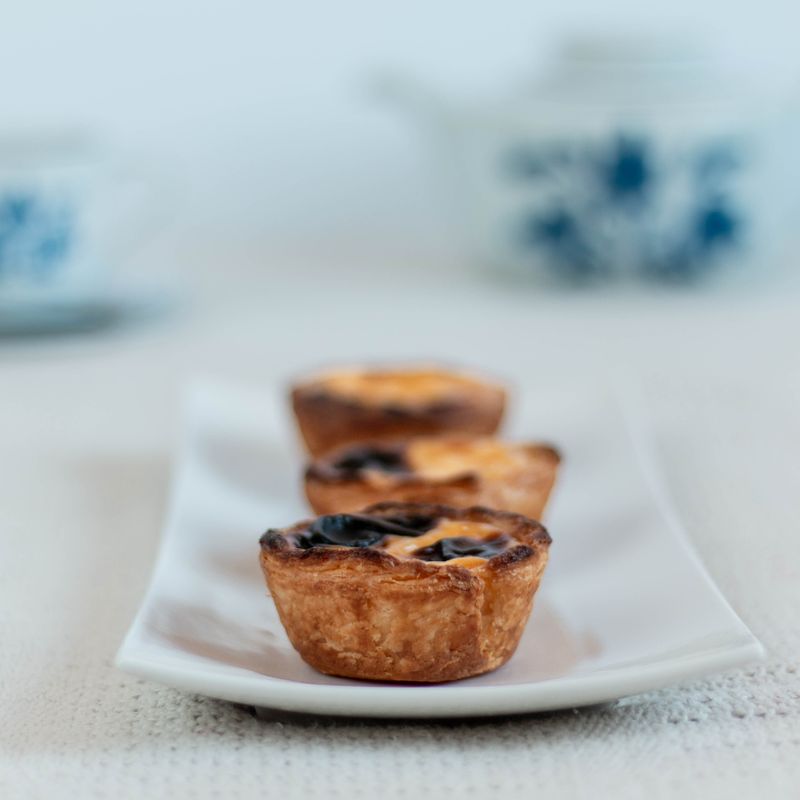
Chinese Egg Tarts (Hong Kong-Style Dan Tat)
Crisp, buttery shortcrust shells filled with a silky, lightly sweet egg custard that bakes up smooth and glossy. A muffin tin makes them easy to bake at home.
- Prep
- 45 min
- Cook
- 25 min
- Wait
- 1 hr 15 min
- Total
- 2 hr 25 min
- Makes
- 12 tarts (about 2¾-inch / 7 cm)
Steps
Before you start
- Cut the butter into cubes and keep it in the fridge until you need it. Cold butter gives a short, flaky crust.
- Plan on about 2½ hours in total. The dough needs 45 minutes to chill and the shells need 15 minutes in the freezer.
- Boil a kettle of water before you start the syrup. The sugar dissolves fully only in very hot water.
- Use a standard 12-cup nonstick muffin tin (cups about 2¾ inches / 7 cm across at the top). Don't use a jumbo or mini tin.
Rub butter into flour
- In a large bowl, whisk the flour, powdered sugar and salt.
- Add the cold butter cubes.
- Toss to coat, then pinch and rub the butter into the flour with your fingertips, working quickly.
- Keep going for about 5 minutes.
+ Show details− Hide details
Ready when: The mixture looks like coarse, damp sand with a few pea-sized butter bits left.
Tip: Work fast and use only your fingertips. If the butter turns greasy and soft, chill the bowl for 10 minutes.
Form the dough
- Mix the egg yolk and ice-cold water together, then drizzle over the crumbs.
- Toss with a fork, then press and knead gently, 4 or 5 times, just until a dough forms.
- Pat into a flat disc, wrap tightly, and refrigerate.
+ Show details− Hide details
Ready when: The dough holds together when squeezed and has no dry patches. It will look slightly crumbly at the edges.
Tip: Don't overwork it. Extra kneading makes tough, shrinking shells.
Chill dough, make syrup
- Refrigerate the dough for 45 minutes.
- While it chills, stir the sugar into the just-boiled water in a spouted bowl until no grains remain, about 1 minute.
- Leave it to cool to lukewarm, about 45 minutes (it should feel barely warm, under 100°F / 38°C).
+ Show details− Hide details
Ready when: The dough feels firm and cold, and the syrup is clear and lukewarm.
Tip: Hot syrup poured onto raw eggs will cook them into flecks. Test the syrup with a clean finger first.
Whisk and strain custard
- In the spouted bowl, gently whisk the eggs with a fork or whisk, keeping the motion slow so you don't whip in foam.
- Stir in the milk and vanilla, then pour in the cooled syrup and stir to combine.
- Pour the mixture through a fine-mesh sieve into a clean jug, then let it sit for 5 minutes.
- Skim off any surface bubbles with a spoon.
+ Show details− Hide details
Ready when: The custard is pale yellow, smooth and free of foam, with no egg threads.
Tip: Straining and skimming gives a glassy, bubble-free top.
Shape the tart shells
- Lightly grease the 12 muffin cups with the softened butter.
- Divide the chilled dough into 12 pieces of about 37 g (1⅓ oz) each and roll into balls.
- Drop one ball into each cup.
- Press it into the base, then push it up the sides with your thumb until the shell is an even ⅛ inch (3 mm) thick and reaches the top rim.
- Prick the bases 2 or 3 times with a fork.
+ Show details− Hide details
Ready when: Shells are even in thickness, with no holes and a slightly raised rim.
Tip: If the dough cracks or turns sticky, chill it for 10 minutes and carry on. Flour your thumb lightly if it sticks.
Freeze shells, preheatOven 400°F / 205°C
- Place the tin on a baking sheet and freeze for 15 minutes.
- Meanwhile, position a rack in the lower third of the oven and preheat to 400°F (200°C).
+ Show details− Hide details
Ready when: The shells are firm to the touch and the oven has reached 400°F (200°C).
Tip: Give the oven the full 15 minutes to preheat. The first hot blast is what sets the crust.
Fill the shells
- Stir the custard gently, then ladle or pour it into each frozen shell, filling them to about ⅛ inch (3 mm) below the rim, using about 2½ tablespoons (35 ml) each.
- Pop any bubbles on the surface with a toothpick.
+ Show details− Hide details
Ready when: Each shell is filled evenly and the custard surface is smooth.
Tip: Filling over the rim causes the custard to puff and then sink, and it also makes the tarts hard to remove.
Bake at high heatOven 400°F / 205°C
- Carry the baking sheet to the oven and bake the tarts at 400°F (200°C) for 10 minutes, without opening the door.
- The pastry edges will begin to turn pale gold and the custard will just start to puff at the edges.
+ Show details− Hide details
Ready when: Pastry rims are pale gold and the custard edges look set while the center is still liquid.
Tip: If the custard rises, puffs or bubbles heavily, lower the heat right away, as the next step does.
Finish at lower heatOven 325°F / 165°C
- Without opening the door for long, reduce the oven to 325°F (165°C) and bake 12 to 15 minutes more.
- The custard should be set but still wobble slightly in the center when you nudge the tin.
- A thermometer in the center should read 170°F (77°C).
+ Show details− Hide details
Ready when: The custard is set with a small jiggle in the very center, the surface is pale yellow with no browning, and the pastry is golden at the edges.
Tip: Overbaking makes the custard rubbery and puts pinholes in it. Take it out when the jiggle is slight, as it keeps cooking.
Cool and unmold
- Rest the tin on a wire rack for 5 minutes.
- Run the tip of a small knife around the edge of each tart and lift it out gently.
- Cool the tarts on the rack for at least 10 minutes more before serving.
- They're best warm or at room temperature.
+ Show details− Hide details
Ready when: Tarts lift out cleanly, the shells feel crisp, and the custard is just warm and firm.
Tip: Leave the tarts too long in the tin and the steam will soften the bottoms. Move them to a rack.
Good to know
Tips
- Keep everything cold when making the pastry. Cold butter melts in the oven and makes the crisp, flaky layers.
- Straining the custard and skimming off the bubbles gives the smooth, glossy surface of bakery tarts.
- If your oven runs hot or the custard puffs up, drop the temperature earlier. A slow bake keeps it silky.
- If your muffin cups are deeper than 1¼ inches (3 cm), line the cups with a bit more dough and top up the custard to match.
Make ahead
"The dough can be made up to 2 days ahead and kept wrapped in the fridge, or frozen for 1 month. Let it sit at room temperature for 10 minutes before dividing. The unbaked shells can be shaped, covered and frozen in the tin for up to 1 week. The custard can be strained and refrigerated for up to 1 day. Bring it to room temperature and stir gently before filling."
Storage & reheating
"Room temperature: up to 4 hours (the custard contains eggs). Fridge: in an airtight container for up to 2 days. Freezer: not recommended after baking, as the custard weeps. To reheat, warm for 5 to 6 minutes in a 300°F (150°C) oven to crisp the shell, and don't microwave."
Substitutions
- whole milk → evaporated milk. Use the same amount, 60 ml (¼ cup), for the richer, more traditional flavor of Hong Kong bakeries.
- powdered sugar → superfine (caster) sugar. Use 35 g (3 tbsp). The shell will be a little less tender.
- unsalted butter → cold salted butter. Use the same amount and leave out the salt in the pastry.
- pure vanilla extract → fresh lemon zest. Use ½ tsp finely grated zest for a lightly fragrant custard.