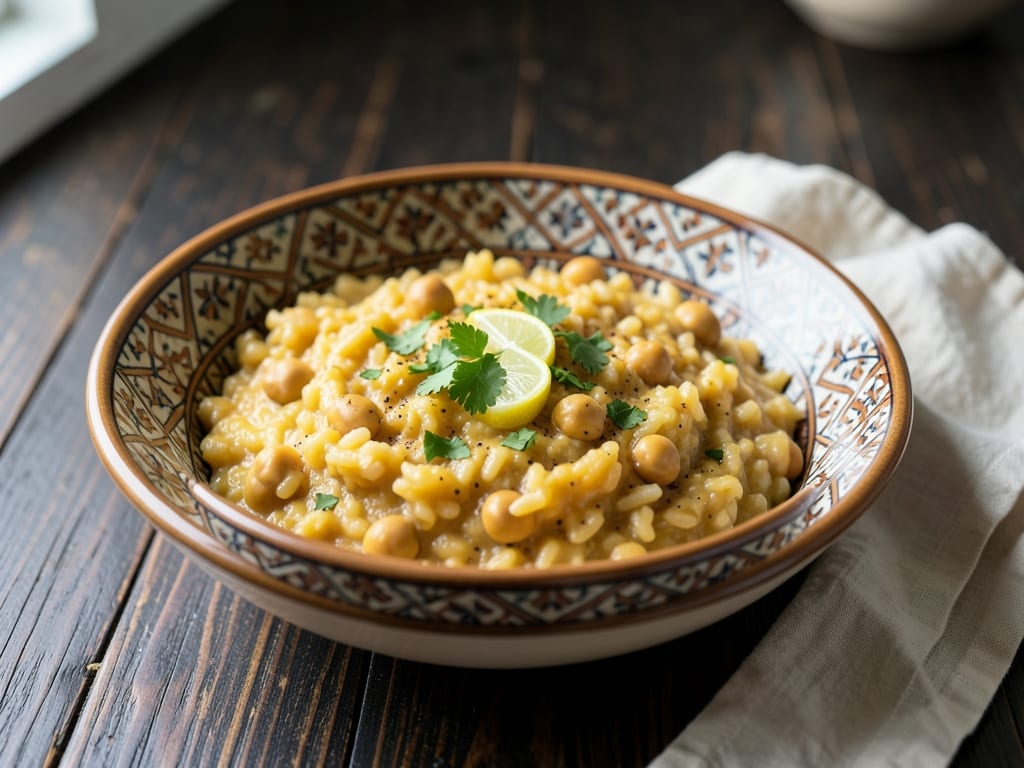
Chickpea and Turmeric Risotto
Creamy vegan risotto with golden turmeric, warm cumin, tender chickpeas and a bright finish of parsley and lemon. Olive oil and a little mashed chickpea give it a rich, silky texture without any dairy.
- Prep
- 15 min
- Cook
- 35 min
- Wait
- 3 min
- Total
- 53 min
- Makes
- 4 main-course servings (about 5 cups / 1.2 L total)
Steps
Before you start
- Measure and chop everything before you turn on the heat; risotto needs your attention once the rice goes in.
- Heat the vegetable broth in a separate saucepan and keep it at a bare simmer. Cold broth slows cooking and makes the rice uneven.
- Drain and rinse the canned chickpeas well. Do not rinse the arborio rice, because its surface starch makes the risotto creamy.
- Plan on about 25 minutes of near-constant stirring after the rice is added.
Heat the broth
- Pour the 5 cups (1.2 L) vegetable broth into a medium saucepan and bring to a bare simmer over medium heat.
- Reduce to low and keep it hot, covered, while you make the risotto.
+ Show details− Hide details
Ready when: Small bubbles break at the edges and steam rises
Tip: Taste the broth. If it is very salty, hold back some of the salt in the risotto.
Prep the chickpeas
- Place the drained, rinsed chickpeas in a bowl.
- Transfer half (about ¾ cup) to a second bowl and mash roughly with a fork so about half are broken and half are still partly whole.
- Leave the other half whole.
+ Show details− Hide details
Ready when: A chunky, uneven mash with no large whole beans in that bowl
Soften the onion
- Heat the olive oil in a large, wide pot over medium heat for 1 minute.
- Add the diced onion and ¼ teaspoon of the salt.
- Cook, stirring often, for 6 to 7 minutes.
+ Show details− Hide details
Ready when: Onion is soft, translucent and glossy with no browning
Tip: Lower the heat if the onion starts to brown; browned onion makes the risotto taste bitter.
Bloom the spices
- Stir in the garlic, cumin and turmeric.
- Cook, stirring constantly, for 45 to 60 seconds so the spices toast in the oil and the garlic smells fragrant.
+ Show details− Hide details
Ready when: Strong aroma of cumin and garlic, oil turns bright yellow
Tip: Turmeric stains. Use a wooden spoon and wipe up spills right away.
Toast the rice
- Add the arborio rice and stir to coat every grain in the golden oil.
- Cook for 2 minutes, stirring constantly.
+ Show details− Hide details
Ready when: Edges of the grains turn translucent while the centers stay white and opaque
Add the wine
- Pour in the white wine and stir.
- Cook, stirring, for 1 to 2 minutes until the wine has been absorbed and the pot smells less sharp.
+ Show details− Hide details
Ready when: Almost no liquid pools when you drag the spoon across the bottom
Tip: Skip the wine and use an extra ½ cup (120 ml) broth plus 1 tablespoon lemon juice if you prefer.
Add broth gradually
- Reduce heat to medium-low.
- Add hot broth about ¾ cup (180 ml) at a time, stirring often.
- Wait until the liquid is mostly absorbed before adding the next ladleful.
- Continue for 20 to 25 minutes, using about 4½ cups (1.1 L) broth in total.
- Keep the mixture at a gentle bubble.
+ Show details− Hide details
Ready when: Rice is creamy and loose, and a spoon drawn across the pot leaves a trail that slowly closes
Tip: If the rice is still hard when the broth is gone, add hot water ¼ cup (60 ml) at a time.
Fold in the chickpeas
- When the rice has about 5 minutes left, stir in all the chickpeas (mashed and whole), the remaining ½ teaspoon salt and the black pepper.
- Add the next ladle of broth and keep stirring.
- The mashed chickpeas will thicken and enrich the sauce.
+ Show details− Hide details
Ready when: Rice is tender with a slight firm bite (al dente) in the center and the risotto is creamy, not soupy
Tip: Bite a grain to check. It should not be chalky in the middle.
Finish and rest
- Remove the pot from the heat.
- Stir in the lemon zest, lemon juice, tahini (if using) and half of the parsley.
- Taste and add salt if needed.
- Cover and rest for 2 minutes to let the risotto relax into a creamy, flowing texture.
+ Show details− Hide details
Ready when: Risotto flows slowly and spreads when spooned onto a plate (all'onda, or wavy)
Tip: If it is too thick, stir in 2 to 3 tablespoons of hot broth or water.
Serve
- Spoon the risotto into warm shallow bowls and scatter with the remaining parsley.
- Serve right away, since risotto thickens as it cools.
Good to know
Tips
- Keep the broth hot. Adding cold liquid drops the pot temperature and gives gummy, uneven rice.
- Stir often but not frantically; regular stirring releases starch for creaminess while a gentle simmer keeps the grains intact.
- Add the lemon juice off the heat so its flavor stays bright and fresh.
- Salt in layers (onion, then rice stage) and taste at the end, since broths vary in saltiness.
Make ahead
Risotto is best fresh. To save time, chop the onion, garlic and parsley and drain the chickpeas up to 1 day ahead and refrigerate them in separate containers. Zest the lemon just before cooking.
Storage & reheating
Refrigerate in an airtight container for up to 3 days. Reheat in a saucepan over low heat with a splash of broth or water (2 to 4 tablespoons per serving), stirring until hot and creamy. Freezing is not recommended because the rice turns mushy. Do not leave at room temperature for more than 2 hours.
Substitutions
- arborio rice → carnaroli or vialone nano rice. Use the same amount. Carnaroli is a little more forgiving and stays firmer.
- dry white wine → extra vegetable broth plus 1 tablespoon lemon juice. Use ½ cup (120 ml) broth and add the lemon juice with the wine step.
- canned chickpeas → cooked white beans such as cannellini. Use the same weight. The flavor is milder but the texture is just as creamy.
- fresh flat-leaf parsley → fresh cilantro or dill. Use the same amount for a different herbal note.