Caramelized Onion and Goat Cheese Dip
A rich, elegant cheese dip with deep, sweet caramelized onions folded together with creamy goat cheese, fresh thyme, and a subtle tang of balsamic vinegar. The slowly caramelized onions—cooked low and patient for nearly an hour—develop complex, almost jam-like sweetness that pairs beautifully with the slight sharpness of chèvre. Serve warm or at room temperature with crackers, crostini, or fresh vegetables for an impressive yet simple appetizer.
Steps
Before you start
- Bring goat cheese to room temperature (30 minutes ahead) so it blends smoothly without lumps
- Use a large 12-inch skillet for even caramelization; smaller pans cause onions to steam instead of brown
- Slice onions evenly so they cook uniformly; uneven pieces will have hard and soft patches
- Have all ingredients measured and crème fraîche ready to go once onions finish cooking
Slice and prepare onions
- Peel 5 large yellow onions.
- Cut each in half lengthwise, then place cut-side down on your cutting board.
- Slice each half thinly—about 1/4 inch thick—into half-moon pieces.
- This yields roughly 10 cups of sliced onions.
- Set aside.
+ Show details− Hide details
Ready when: Onions are uniformly sliced to roughly 1/4-inch thickness
Tip: Slice evenly so they cook uniformly; thicker pieces will remain raw while thin ones burn if you're not careful.
Melt butter and add onions
- In your 12-inch skillet with a heavy bottom, melt 2 oz unsalted butter over medium-high heat.
- Once the butter is foaming, add all the sliced onions and stir well to coat completely in the butter.
- Spread them evenly in the pan.
+ Show details− Hide details
Ready when: Onions are glistening with butter and starting to soften slightly at the edges
Tip: A large skillet is essential—it gives onions room to caramelize rather than steam. Crowding them in a small pan traps moisture and ruins the process.
Slow-caramelize onions until deep brown
- Reduce heat to medium.
- Cook the onions uncovered for 45 to 50 minutes total, stirring every 5 to 8 minutes.
- This slow cooking is where all the flavor develops—don't skip or rush it.
- The onions will gradually transform from raw and pungent to soft, then pale golden, then deep caramel brown.
- Adjust heat down slightly if the bottom starts to scorch faster than the top caramelizes.
- If the pan looks dry at any point, add a splash of water (1–2 tbsp) to deglaze and release the stuck-on goodness, then continue cooking.
+ Show details− Hide details
Ready when: Onions are deep golden-brown to mahogany in color, very soft and tender, and smell intensely sweet and caramelized (not burnt)
Tip: Frequent stirring prevents burnt spots and ensures even caramelization. The color should progress gradually; if it jumps from golden to dark too quickly, your heat is too high.
Add thyme and balsamic vinegar
- Stir in 2 tbsp fresh thyme leaves (or 2 tsp dried thyme) and 3 tbsp balsamic vinegar.
- Cook, stirring, for 1 minute so the vinegar reduces slightly and the flavors meld together.
- The pan will smell aromatic and slightly sweet.
+ Show details− Hide details
Ready when: Balsamic vinegar is slightly syrupy and no longer smells sharp; thyme aroma rises from the pan
Tip: Fresh thyme is recommended for brighter flavor; add it at the very end. If using dried thyme, add it earlier (step 3) so it rehydrates fully.
Blend caramelized onions with cheese
- Transfer the warm caramelized onions (scraping in all the butter and browned bits at the pan's bottom) to a food processor or blender.
- Add 8 oz crumbled goat cheese (at room temperature), 1/2 cup crème fraîche, and 2 minced garlic cloves.
- Pulse until creamy and spreadable but still showing visible soft chunks of onion—don't over-blend to a smooth paste.
- The texture should be rustic and chunky-creamy, not baby food.
+ Show details− Hide details
Ready when: Mixture is creamy and spreadable with visible soft onion pieces; no dry lumps of cheese or large onion chunks remain
Tip: A food processor with a pulse function gives you much better control than a blender for achieving the right texture. Room-temperature goat cheese blends smoothly without breaking.
Season and taste the dip
- Transfer the blended dip to a serving bowl.
- Taste a small spoonful and season with salt and freshly ground black pepper to your preference.
- Stir in a tiny pinch more fresh thyme if desired.
- Note: goat cheese already contains salt, so add cautiously.
+ Show details− Hide details
Ready when: Dip is well-balanced—sweet from onions, tangy from goat cheese, herbal and savory overall; no single flavor dominates
Tip: Taste just before serving; flavors can shift as the dip cools. The overall profile should be rich and complex, not one-note.
Serve with accompanimentsOven 300°F / 150°C
- Serve the dip at room temperature or gently warmed.
- To warm, transfer to an oven-safe bowl and heat in a 300°F (150°C) oven for 8 to 10 minutes until warmed through (do not overheat).
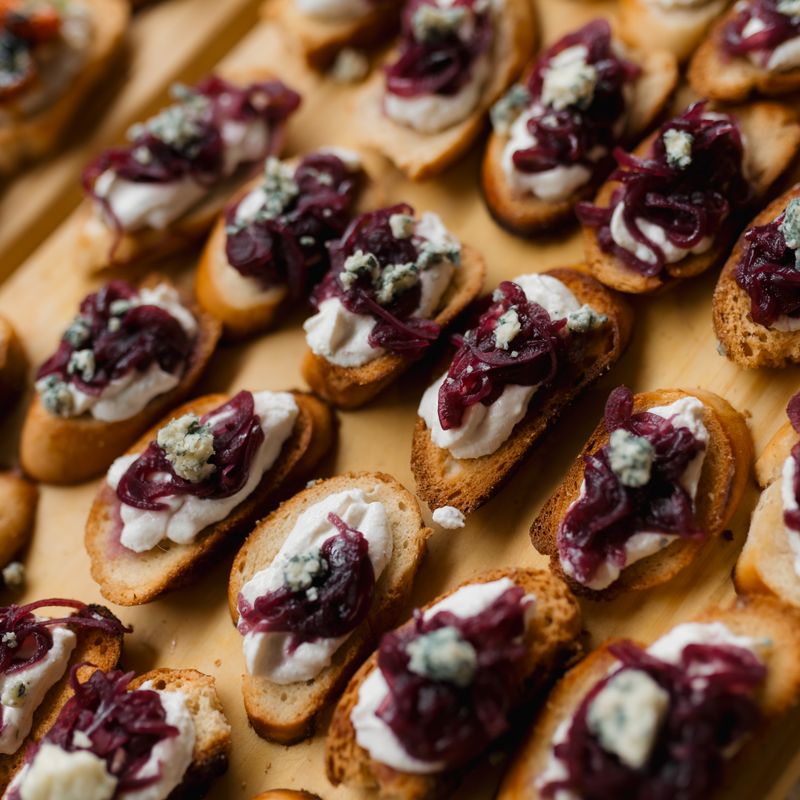
- Arrange alongside crackers, crostini, toasted baguette slices, or fresh vegetables such as apple slices, celery, radishes, endive leaves, or cucumber rounds.
- Garnish with a few fresh thyme leaves for color.
+ Show details− Hide details
Ready when: Dip is warm throughout and ready to serve
Tip: The dip tastes best at room temperature or slightly warm. Avoid heating above 350°F (175°C), as intense heat can break the goat cheese.
Good to know
Tips
- Caramelizing onions slowly is the key to this recipe. Rushing the process by cooking on high heat results in unevenly caramelized, even scorched onions with an acrid taste. Low-and-slow yields deep, jammy sweetness.
- Scrape the very bottom of the pan when transferring onions to the processor—those browned, caramelized bits are pure flavor and should not be left behind.
- Taste the dip just before serving and adjust salt carefully. Different goat cheese brands vary in saltiness; you may need less (or more) than you'd expect.
- This dip is excellent for entertaining because it can be made 1–2 days ahead. Simply cover and refrigerate, then serve at room temperature or warm gently right before guests arrive.
Make ahead
Yes. Make the dip up to 2 days in advance. Store in an airtight container in the fridge. Bring to room temperature before serving, or gently warm in a 300°F (150°C) oven for 8–10 minutes. The dip actually improves after a day as flavors meld.
Storage & reheating
Room temperature: up to 2 hours (best within 1 hour). Refrigerator: up to 3 days in an airtight container (bring to room temperature or gently warm before serving). Freezer: up to 3 months in a freezer-safe container (thaw overnight in the fridge, then bring to room temperature or warm gently in the oven).
Substitutions
- fresh goat cheese (chèvre) → cream cheese (8 oz) or ricotta. Less tangy than goat cheese but equally creamy. Use room-temperature cream cheese for smooth blending. Ricotta will be slightly grainier but still delicious.
- crème fraîche → sour cream or full-fat Greek yogurt. Both work well for creaminess. Sour cream may add slight tang; Greek yogurt will make the dip slightly thicker. Use equal amounts.
- balsamic vinegar → red wine vinegar or sherry vinegar. Both are less sweet than balsamic; use 2–3 tbsp and taste as you go. The dip will be slightly sharper and less glossy-looking.
- fresh thyme → fresh rosemary, oregano, or a blend of dried Italian herbs. Rosemary is bold; use only 1 tbsp fresh or ½ tsp dried. Oregano is earthier; use the same amount as thyme. Italian herbs soften the edges.