
Caramel Apple Breakfast Ring
A stunning bundt-style coffee cake with soft, buttery crumb, tender cinnamon-spiced apples, and a gooey caramel layer studded with toasted walnuts. Perfect for weekend breakfast or brunch, with a dramatic caramel crown when inverted.
- Prep
- 25 min
- Cook
- 50 min
- Wait
- 15 min
- Total
- 1 hr 30 min
- Makes
- 1 ring cake (12 slices)
Steps
Before you start
- Preheat oven to 350°F (175°C)
- Butter and flour a 10-inch (25 cm) bundt pan thoroughly, paying special attention to the center tube
- Bring eggs and buttermilk to room temperature
- Toast walnuts in a dry skillet over medium heat for 3–4 minutes until fragrant, then chop
Prepare caramel base
- In a medium saucepan over medium heat, melt 4 tbsp (57 g) butter with 0.75 cup (165 g) brown sugar, stirring constantly, until combined and bubbling at the edges, about 2 minutes.
- Remove from heat and stir in 0.25 cup (60 ml) heavy cream and 0.5 tsp (3 g) salt.
- The mixture will bubble gently—this is normal.
- Let cool for 1 minute, then stir in 0.75 cup (85 g) toasted chopped walnuts.
- Pour this mixture evenly into the prepared bundt pan, making sure it coats the bottom and center tube.
+ Show details− Hide details
Ready when: Caramel is smooth and bubble gently; walnuts are fully coated
Tip: Don't skip letting the caramel cool—pouring boiling caramel into the pan and directly onto eggs can cause steam pockets in the cake.
Mix apple cinnamon coating
- In a small bowl, combine 1 tsp (2.5 g) cinnamon and 2 tbsp (25 g) sugar.
- Toss the 3 cups (450 g) diced apples with this mixture until evenly coated.
- Set aside.
+ Show details− Hide details
Ready when: Apples are evenly coated with cinnamon sugar
Cream butter and sugar
- In a large mixing bowl, beat 0.75 cup (170 g) softened butter and 1 cup (200 g) granulated sugar together with an electric mixer on medium-high speed for 2–3 minutes, until the mixture is pale, fluffy, and about doubled in volume.
- Scrape down the bowl as needed.
+ Show details− Hide details
Ready when: Mixture is pale, light, and noticeably fluffy
Tip: Don't rush this step—creaming incorporates air that helps the cake rise evenly.
Add eggs
- Add the 3 eggs one at a time to the creamed mixture, beating well after each addition (about 30 seconds per egg) on medium-high speed.
- The batter should look smooth and slightly thick; if it looks curdled or separated, it's fine—it will come together as you continue to mix.
+ Show details− Hide details
Ready when: Batter is smooth and pale; eggs are fully incorporated
Tip: Room-temperature eggs incorporate more smoothly than cold ones, reducing the risk of a curdled-looking batter.
Add vanilla
- Pour in 1.5 tsp (7.5 ml) vanilla extract and beat on medium speed for 15 seconds until combined.
+ Show details− Hide details
Ready when: Vanilla is evenly distributed; no streaks visible
Combine dry ingredients
- In a medium bowl, whisk together 2 cups (250 g) all-purpose flour, 1.5 tsp (7.5 g) baking powder, 0.25 tsp (1.2 g) baking soda, 0.25 tsp (1.5 g) table salt, and 1 tsp (2.5 g) cinnamon until no lumps remain.
+ Show details− Hide details
Ready when: Mixture is uniform in color with no white streaks or lumps
Alternate flour and buttermilk
- Reduce the mixer to low speed.
- Add one-third of the dry mixture to the wet batter and mix until just combined (about 15 seconds).
- Add half of the 0.5 cup (120 ml) buttermilk and mix for another 15 seconds.
- Repeat with another third of the dry mix, the remaining buttermilk, and finish with the last third of the dry mix, mixing after each addition until just combined.
- Do not overmix; some streaks of dry flour are okay and will disappear during baking.
+ Show details− Hide details
Ready when: Batter is smooth with no visible streaks; flour is barely combined
Tip: Overmixing the batter at this stage develops gluten and creates a tough, dense cake. Stop as soon as you don't see dry flour.
Fold in apples
- Using a flexible spatula or wooden spoon, gently fold the cinnamon-coated apple pieces into the batter with about 8–10 folds, just until they are evenly distributed.
- Don't worry if a few small streaks of batter remain visible.
+ Show details− Hide details
Ready when: Apples are evenly distributed throughout the batter
Tip: Fold gently to avoid breaking the apple pieces and crushing air out of the batter.
Fill bundt pan
- Carefully pour the batter over the caramel and walnut base in the bundt pan, spreading it gently with a spatula to fill all the nooks and ensure an even layer.
- The caramel should stay at the bottom; don't mix it into the batter.
+ Show details− Hide details
Ready when: Batter completely covers the caramel base and fills the pan evenly
Tip: Pour slowly and spread gently to keep the caramel and walnuts from being pushed around.
Bake cakeOven 350°F / 175°C
- Place the bundt pan in the preheated 350°F (175°C) oven and bake for 45–50 minutes, until a toothpick inserted into the thickest part of the cake (avoiding the apples) comes out with a few moist crumbs, or the cake registers 205–210°F (96–99°C) on an instant-read thermometer inserted into the center.
- The top should be lightly golden and spring back when gently pressed.
+ Show details− Hide details
Ready when: Toothpick comes out with just a few moist crumbs; internal temperature is 205–210°F; top is golden and springs back
Tip: Start checking at 40 minutes; bundt pans vary in heat distribution. A few moist crumbs are fine—pulling the cake out slightly underbaked ensures it stays moist.
Cool and invert
- Let the cake cool in the pan for exactly 10 minutes—no more, no less.
- Run a thin knife or offset spatula around the inner and outer edges of the bundt pan to loosen the cake.
- Place a serving plate over the bundt pan and, using both hands, quickly and confidently flip the plate and pan together so the cake lands caramel-side up on the plate.
- Leave the pan in place for 1–2 minutes, then carefully lift it away.
- If any caramel sticks to the pan, gently warm the pan briefly and encourage the caramel onto the cake with a spatula.
- Let the cake cool on the plate for another 3–5 minutes before serving.
+ Show details− Hide details
Ready when: Caramel has set slightly but is still warm and pliable; cake is loose all around the edges
Tip: The 10-minute window is critical: too short and the cake will fall apart, too long and the caramel will be too firm to release from the pan. Be decisive when inverting.
Good to know
Tips
- Room-temperature eggs and buttermilk emulsify more smoothly into the butter mixture, preventing a curdled-looking batter.
- Toast the walnuts in a dry skillet before chopping—this intensifies their flavor and ensures they're not raw or rubbery.
- If the caramel is still in the pan after inverting, gently warm the outside of the bundt pan with a kitchen torch or hold it briefly over medium heat to warm and soften the caramel so it releases fully.
- This cake is best served warm or at room temperature, when the caramel is soft and gooey. Cold cake can have a harder caramel layer, though it will soften as it sits at room temperature.
Storage & reheating
Store the cooled cake covered at room temperature for up to 2 days. The cake does not freeze well due to the caramel base. To reheat a slice, warm it gently in a 300°F (150°C) oven for 5–7 minutes to soften the caramel slightly.
Substitutions
- medium apples (Honeycrisp or Granny Smith), peeled, cored, and diced → pears or a mix of apples and pears. Use the same weight. Pears are slightly softer and will dissolve a bit more into the cake; dice them just before mixing to prevent browning.
- walnuts, toasted and chopped → pecans or toasted sliced almonds. Use the same weight. Pecans are slightly sweeter; almonds add a more delicate crunch. Toast before chopping.
- packed light brown sugar → 0.75 cup (150 g) granulated sugar plus 1 tbsp (15 ml) molasses. Whisk the molasses into the melted butter before adding the granulated sugar to replicate the depth of brown sugar.
- buttermilk, at room temperature → Greek yogurt thinned with milk (0.25 cup Greek yogurt plus 0.25 cup whole milk). Whisk together until smooth. Greek yogurt makes a slightly denser, more tender crumb.
More breakfast bakes
See all →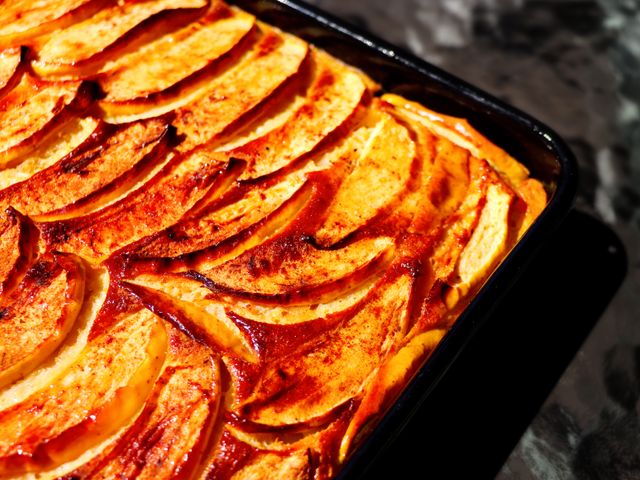



Find more like this
- Meal
- Breakfast
- Main ingredient
- Apples
- Diet
- VegetarianHalal
- Method
- Oven