Buttermilk Scones
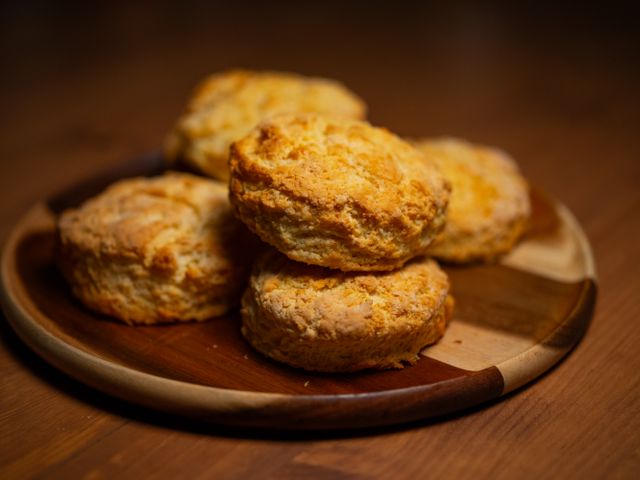
Tall, tender, flaky British-style scones made by cutting cold butter into flour and bringing the dough together with tangy buttermilk. Serve warm with jam and clotted or whipped cream.
- Prep
- 25 min
- Cook
- 17 min
- Wait
- 35 min
- Total
- 1 hr 17 min
- Makes
- 8 scones (about 2½-inch / 6 cm rounds)
Steps
Before you start
- Keep the butter and buttermilk in the fridge until the moment you use them; cold ingredients make flaky scones.
- Cut the butter into cubes and chill it in the freezer for 10 minutes while you gather everything else.
- Position an oven rack in the center and line a baking sheet with parchment paper.
- Weigh the flour if you can: scooping packs in extra flour and makes dry, tough scones.
- Allow about 1 hour 15 minutes in total, including 25 minutes of chilling and 10 minutes of cooling.
Heat oven, prep panOven 425°F / 220°C
- Place a rack in the center of the oven and preheat to 425°F (220°C).
- Line a rimmed baking sheet with parchment paper.
- Put the cubed butter in the freezer for 10 minutes.
+ Show details− Hide details
Ready when: Butter cubes feel very cold and firm
Whisk dry ingredients
- In a large bowl, whisk the flour, sugar, baking powder, baking soda and salt for 30 seconds until evenly combined with no lumps of baking soda.
+ Show details− Hide details
Ready when: Mixture looks uniform and pale
Cut in butter
- Add the cold butter cubes.
- Toss to coat, then cut in with a pastry cutter or press cubes flat between your fingertips, working quickly.
- Stop when the mixture looks like coarse crumbs with some pea-sized and some almond-sized butter pieces remaining.
+ Show details− Hide details
Ready when: Coarse crumbs with visible flakes of butter; no sandy, uniform texture
Tip: Those visible butter pieces melt in the oven and create flaky layers. If the butter feels soft, chill the bowl for 10 minutes.
Mix wet ingredients
- In a measuring jug, whisk ¾ cup (180 ml) buttermilk with the beaten egg and vanilla until smooth.
+ Show details− Hide details
Ready when: Liquid is uniformly pale yellow
Form shaggy dough
- Make a well in the dry mixture and pour in the wet mixture.
- Stir with a fork about 15 strokes until a shaggy, sticky dough forms with a few dry patches.
- If large patches of flour remain, add 1 tablespoon more buttermilk.
+ Show details− Hide details
Ready when: Dough holds together when pinched but still looks rough
Tip: Overmixing develops gluten and makes scones tough and flat.
Fold and pat out
- Turn the dough onto a lightly floured counter.
- With floured hands, knead gently 4 or 5 times just to bring it together.
- Pat into a 7-inch (18 cm) round about 1¼ inches (3 cm) thick.
- Fold in half, turn, and pat out again to the same size and thickness once more for extra layers.
+ Show details− Hide details
Ready when: Dough is cohesive, slightly tacky, and about 1¼ inches thick
Tip: Do not roll it thinner; thick dough gives tall scones.
Cut the scones
- Dip the 2½-inch (6 cm) cutter in flour and press straight down without twisting; twisting seals the edges and limits the rise.
- Cut 6 rounds, gently gather the scraps, pat out and cut 2 more.
- Place on the lined sheet about 2 inches (5 cm) apart.
+ Show details− Hide details
Ready when: 8 rounds with clean, straight sides
Tip: Scones from scraps will be slightly less tender, so bake them as the 'cook's treat'.
Chill the scones
- Refrigerate the tray of cut scones for 15 minutes so the butter firms up again and the scones hold their shape in the oven.
+ Show details− Hide details
Ready when: Tops feel cool and firm to the touch
Glaze the tops
- Brush the tops (not the sides, which can glue the layers shut) with 2 tablespoons buttermilk.
- Sprinkle with coarse sugar, if using.
+ Show details− Hide details
Ready when: Tops look evenly damp
Tip: Avoid letting glaze drip down the sides.
Bake until goldenOven 425°F / 220°C
- Bake at 425°F (220°C) for 15 to 18 minutes, rotating the pan front to back after 10 minutes, until the scones are risen and deep golden brown on top and bottom.
- A skewer in the center should come out clean.
+ Show details− Hide details
Ready when: Deep golden tops, golden-brown bottoms, and sides that feel firm and sound hollow when tapped
Tip: Do not open the oven before 10 minutes, or the rise may collapse.
Cool briefly and serve
- Transfer the scones to a wire rack and cool for 10 minutes; they are at their best warm.
- Split and serve with jam and clotted or whipped cream.
+ Show details− Hide details
Ready when: Scones are warm, not hot, and the crumb is set
Good to know
Tips
- Keep everything cold: if the dough turns greasy or soft while you work, chill it for 10 minutes before continuing.
- Handle the dough as little as possible; a slightly shaggy, sticky dough gives the most tender scones.
- Press the cutter straight down and up without twisting for the tallest rise.
- For fruit scones, fold ½ cup (75 g) of currants or raisins into the dry mixture before adding the liquid.
Make ahead
Cut the scones, place them on the parchment-lined tray and freeze until solid (about 1 hour), then bag them for up to 1 month. Glaze and bake straight from frozen at 425°F (220°C) for 18 to 22 minutes, skipping the chill step.
Storage & reheating
Room temperature in an airtight container for up to 2 days. Freeze baked scones, wrapped well, for up to 2 months. Reheat room-temperature or thawed scones at 350°F (175°C) for 5 to 8 minutes until warm and the crust is crisp again. Avoid refrigerating, which dries them out.
Substitutions
- buttermilk → Whole milk plus lemon juice or white vinegar. Stir 2 teaspoons of lemon juice or vinegar into ¾ cup plus 2 tablespoons (210 ml) of milk and rest 5 minutes; use for both the dough and the glaze.
- all-purpose flour → Half white whole wheat flour. Replace up to 150 g of the flour; the scones will be a little denser and may need 1 extra tablespoon of buttermilk.
- unsalted butter → Cold vegan butter sticks. Use firm stick-style, not tub spread, and pair with a plant-based buttermilk for a dairy-free version.
- vanilla extract → Finely grated lemon zest. Use 1 tablespoon (about 6 g) of zest for a bright, citrusy flavor.