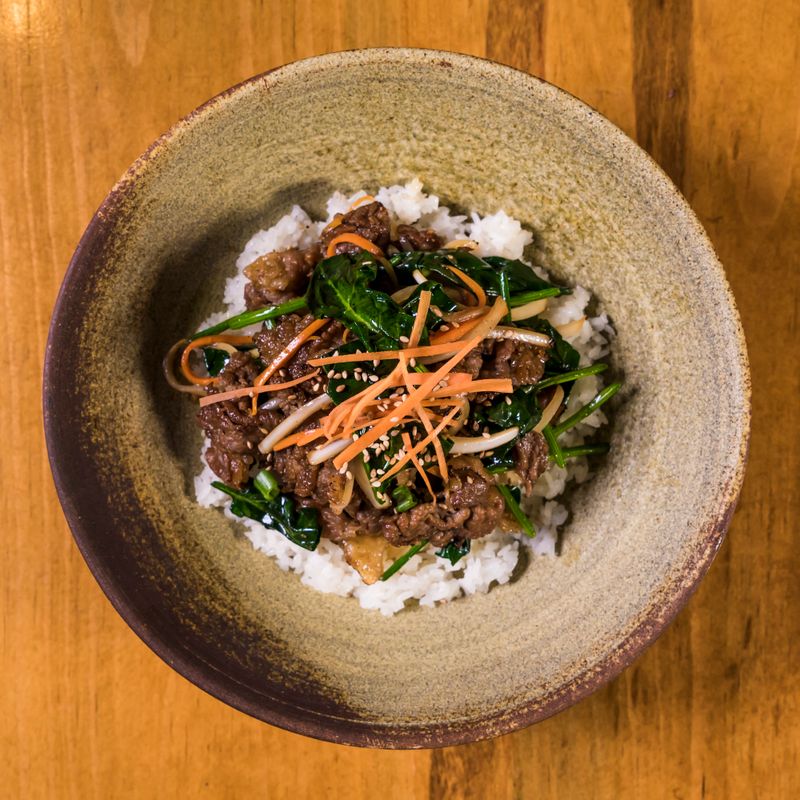
Bulgogi Beef Lasagna
Sweet-savory bulgogi beef with garlic, ginger, and sesame is layered with tender noodles, creamy béchamel, and stretchy mozzarella, then baked until bubbling and finished with fresh scallions and toasted sesame seeds.
- Prep
- 37 min
- Cook
- 1 hr 22 min
- Wait
- 1 hr
- Total
- 2 hr 59 min
- Makes
- 1 lasagna in a 9×13-inch pan (8 generous squares)
Steps
Before you start
- Put the beef in the freezer for 15 minutes before slicing (step 1). Partially frozen beef slices much thinner and more evenly.
- Shred the mozzarella from a block yourself if you can. Pre-shredded cheese is coated in starch and melts less smoothly.
- Warm the milk in the microwave (about 2 minutes) before you make the béchamel. Warm milk blends into the roux without lumps.
- Read the timing: the beef marinates for 30 minutes, and the finished lasagna must rest 15 minutes before slicing.
- Bulgogi is salty and sweet, so the béchamel and noodle water are seasoned lightly. Don't add extra salt until you taste the finished dish.
Chill and slice beef
- Place the trimmed steak on a plate in the freezer for 15 minutes, until the outside is firm but the center still gives slightly when pressed.
- Using a sharp knife, slice the steak across the grain as thinly as you can, about ⅛ inch (3 mm).
- Stack a few slices at a time and cut them into ½-inch (1 cm) pieces.
- Transfer to a large mixing bowl.
+ Show details− Hide details
Ready when: Slices are thin enough to bend easily and pieces are about ½ inch (1 cm)
Tip: Don't freeze the beef solid. Partially frozen is the goal, and a rock-hard center will crush the knife's edge and tear the meat.
Marinate the beef
- Add the soy sauce, brown sugar, grated pear with its juice, garlic, ginger, sesame oil, gochujang (if using), and black pepper to the beef.
- Stir well with your hands or a spoon so each piece is coated.
- Cover and refrigerate for 30 minutes (up to 4 hours).
- The grated pear contains an enzyme that tenderizes the meat, so don't marinate beyond 4 hours.
+ Show details− Hide details
Ready when: Beef is evenly coated and sitting in a loose, dark marinade
Boil the noodles
- While the beef marinates, bring a large pot of water (about 5 quarts / 4.7 L) to a boil.
- Add the 1 tablespoon salt and the noodles.
- Cook, stirring occasionally in the first minute so they don't stick, for about 8 minutes, or 1 to 2 minutes less than the package says.
- Drain, rinse briefly with cool water, then lay the noodles flat in a single layer on a lightly oiled baking sheet or a clean counter so they don't stick together.
+ Show details− Hide details
Ready when: Noodles are flexible and bend without breaking but are still slightly firm in the center (they finish cooking in the oven)
Tip: Underdone noodles are the goal. Fully soft noodles turn mushy after 50 minutes of baking.
Sear the bulgogi
- Heat 1 tablespoon of the neutral oil in a 12-inch (30 cm) skillet over medium-high heat.
- Add the sliced onion and cook, stirring occasionally, for 4 minutes until softened and lightly browned at the edges.
- Transfer to a plate.
- Return the skillet to high heat with the remaining 1 tablespoon oil.
- Using a slotted spoon, lift the beef out of the marinade (reserve the liquid in the bowl) and sear it in 3 batches, spreading it in a single layer and leaving it undisturbed for 1 minute, then stirring for 1 to 2 minutes more.
- Return all the beef and onion to the skillet, pour in the reserved marinade, and simmer for 3 to 4 minutes, stirring, until the liquid reduces to a thick, glossy glaze that barely pools.
- Stir in 3 of the sliced scallions and remove from heat.
+ Show details− Hide details
Ready when: Beef is browned with no pink remaining and the sauce coats the meat like a glaze, with almost no loose liquid in the pan
Tip: Crowding the pan steams the beef instead of searing it. Work in batches, and make sure the sauce is reduced, because a wet filling makes soupy lasagna.
Make the béchamel
- Melt the 4 tablespoons butter in a 3-quart (2.8 L) saucepan over medium heat.
- Whisk in the flour and cook, whisking constantly, for 2 minutes until it smells lightly nutty and looks like wet sand but has not browned.
- Pour in about 1 cup (240 ml) of the warm milk while whisking vigorously until a thick, smooth paste forms.
- Gradually whisk in the remaining milk.
- Cook, whisking often and scraping the corners, for 6 to 8 minutes until the sauce comes to a gentle bubble and coats the back of a spoon.
- Whisk in the ¾ teaspoon salt and the white pepper.
+ Show details− Hide details
Ready when: Sauce is smooth, thick enough to coat a spoon, and a finger drawn across the spoon leaves a clean line
Tip: Add the first cup of milk slowly while whisking. Dumping it in all at once causes lumps. If lumps do form, whisk hard or pour through a sieve.
Assemble the layersOven 375°F / 190°C
- Preheat the oven to 375°F (190°C) with a rack in the center.
- Grease a 9×13-inch (23×33 cm) baking dish with the softened dish butter.
- Spread 3/4 cup (180 ml) béchamel over the bottom.
- Arrange 3 noodles side by side across the dish, trimming to fit if needed.
- Spread one-third of the beef (about 1 heaping cup) over the noodles, drizzle with 1 cup (240 ml) béchamel, and sprinkle with one-quarter of the mozzarella (about 85 g).
- Repeat to make a second layer of 3 noodles, one-third of the beef, 1 cup béchamel, and another quarter of the cheese.
- For the final layer, add the last 3 noodles, the remaining beef, and the remaining béchamel (about 1¼ cups / 300 ml), then top with the remaining half of the mozzarella (170 g).
- Grease one side of a large sheet of foil with a little butter and cover the dish, buttered side down.
+ Show details− Hide details
Ready when: Dish is filled with three even layers and a smooth, fully covered top
Tip: Spread the béchamel all the way to the corners and edges so no noodles are left bare, because exposed noodles turn hard and dry.
Bake coveredOven 375°F / 190°C
- Place the dish on a rimmed baking sheet to catch drips and bake, covered, at 375°F (190°C) for 30 minutes, until the edges are bubbling and the lasagna is heated through.
+ Show details− Hide details
Ready when: Béchamel is bubbling around the edges of the dish
Uncover and brownOven 375°F / 190°C
- Remove the foil carefully, away from your face, since the steam is hot.
- Return the lasagna to the oven and bake, uncovered, at 375°F (190°C) for 20 minutes more, until the top is golden brown in spots and bubbling.
- Check that the center registers 165°F (74°C) on an instant-read thermometer.
- If the top isn't browned, broil on high for 1 to 2 minutes, watching closely.
+ Show details− Hide details
Ready when: Top is golden with browned spots, edges are bubbling, and the center reads 165°F (74°C)
Tip: Broiler time is short: cheese goes from golden to burnt in under a minute.
Rest and garnish
- Let the lasagna rest on a wire rack for 15 minutes so the béchamel sets and the layers hold together when cut.
- Sprinkle with the remaining 5 sliced scallions and the toasted sesame seeds.
- Cut into 8 squares with a sharp knife and serve with a spatula.
+ Show details− Hide details
Ready when: Bubbling has stopped and the edges are set enough to cut clean squares
Tip: Cutting too early causes the layers to slump and the sauce to run out.
Good to know
Tips
- Slice the beef thinly and then chop it. Large strips of bulgogi pull out of the slices when you cut the lasagna.
- Reduce the bulgogi sauce until it clings to the meat. Too much liquid in the filling is the most common cause of a watery lasagna.
- Undercook the noodles slightly and rinse them. They keep absorbing moisture in the oven.
- Serve with kimchi or quick-pickled cucumbers on the side to cut through the richness.
Make ahead
"Assemble the lasagna through step 6, cover tightly with buttered foil, and refrigerate up to 24 hours. Bake from cold at 375°F (190°C) covered for 45 minutes, then uncovered for 20 minutes, until the center reaches 165°F (74°C). The bulgogi filling alone can be cooked and refrigerated up to 2 days ahead."
Storage & reheating
Room temperature: up to 2 hours after baking. Refrigerator: cover tightly and store up to 4 days. Freezer: wrap individual squares well and freeze up to 3 months; thaw overnight in the fridge. Reheat covered with foil at 350°F (175°C) for 20 to 25 minutes (squares) until hot in the center, or microwave a single square at 70% power for 2 to 3 minutes.
Substitutions
- Asian pear → Grated Fuji or Bosc apple, or grated sweet pear. Use the same amount; an apple gives similar sweetness and tenderizing.
- boneless ribeye or sirloin steak → 1.5 lb (680 g) ground beef (80% lean). Skip the slicing step, marinate the same way, and brown the meat well in batches, breaking it into small crumbles. Cook to 160°F (71°C).
- gochujang (Korean chili paste) → 1 tsp crushed red pepper flakes or omit. Leave it out for a mild, kid-friendly version.
- whole milk → Whole-milk oat milk or low-fat milk. Whole milk gives the richest sauce; lower-fat milks produce a thinner béchamel, so cook it 1 to 2 minutes longer.