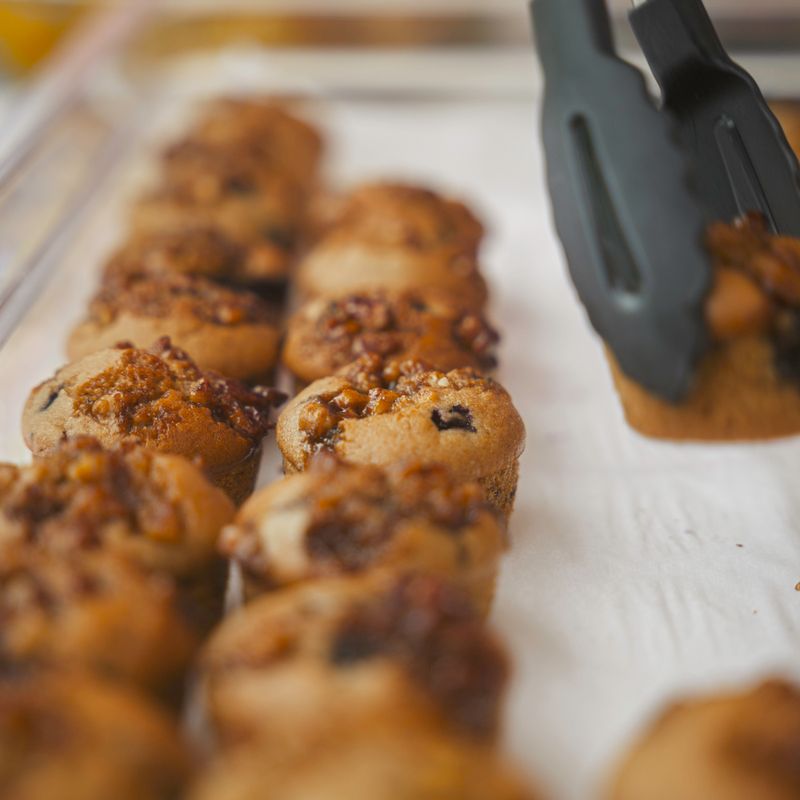
Brown Butter Sage Muffins
Savory muffins with the toasted, nutty flavor of brown butter paired with fresh sage leaves, Parmesan cheese, and a whisper of lemon. Tender, moist, and perfect warm from the oven for breakfast, brunch, or alongside soup.
Steps
Before you start
- Preheat oven to 400 °F (200 °C) and line a 12-cup muffin tin with paper liners
- Brown the butter early so it has time to cool completely before mixing
- Have all dry ingredients measured and ready
- Use fresh sage; dried sage is too concentrated and will overpower the muffins
Brown the butter
- In a small saucepan, melt 6 tablespoons (85 g) unsalted butter over medium heat.
- Continue cooking, stirring occasionally, until the milk solids settle and toast to a deep golden brown with a nutty aroma, about 5–7 minutes.
- Watch carefully so it doesn't burn.
- Pour into a bowl and let cool completely to room temperature (about 10 minutes), scraping in all the flavorful solids.
+ Show details− Hide details
Ready when: Butter is deep golden brown with a rich, nutty aroma and no burnt smell
Tip: Do not skip the cooling step; warm brown butter will cook the eggs when mixed. Brown butter can splatter, so use a lid or splatter screen if needed.
Chop the sage
- While the butter cools, finely chop 12 fresh sage leaves until they are roughly 1/8 inch (3 mm) pieces.
- Set aside.
Mix dry ingredients
- In a medium bowl, whisk together 1¾ cups (220 g) all-purpose flour, 2 teaspoons (8 g) baking powder, ½ teaspoon (3 g) fine sea salt, and ¼ teaspoon (0.5 g) freshly ground black pepper.
- Set aside.
+ Show details− Hide details
Tip: Whisking aerates the flour and distributes the leavening evenly.
Whisk wet ingredients
- In a large bowl, whisk together the cooled brown butter (with all the toasted solids), 2 large room-temperature eggs, ¼ cup (50 g) granulated sugar, and ½ cup (120 ml) whole milk until fully combined and smooth.
- If using lemon zest, stir in 1 teaspoon (2 g) finely grated lemon zest now.
+ Show details− Hide details
Ready when: Mixture is smooth, no egg streaks visible
Tip: Do not overmix at this stage; a light touch in the next step is key to tender muffins.
Combine wet and dry
- Gently pour the dry mixture into the wet mixture.
- Using a fork or wooden spoon, fold together just until the flour is barely incorporated—the batter should be lumpy and thick, not smooth.
- Overmixing develops gluten and makes tough muffins.
+ Show details− Hide details
Ready when: Flour is no longer visible; batter is lumpy and chunky
Tip: Stop as soon as you see no more dry streaks. A few flour lumps are fine and will make tender crumbs.
Fold in sage and Parmesan
- Gently fold in the chopped fresh sage and ⅓ cup (40 g) freshly grated Parmesan cheese until just combined.
- The batter is now ready to portion.
+ Show details− Hide details
Ready when: Sage and cheese are evenly distributed throughout the batter
Tip: Reserve a small pinch of Parmesan to sprinkle on top of each muffin before baking for extra cheese flavor and a crispy top.
Fill the muffin tin
- Divide the batter evenly among the 12 lined muffin cups, filling each about two-thirds full.
- The batter will be thick and chunky.
- If you reserved Parmesan for topping, sprinkle a tiny pinch on top of each muffin.
+ Show details− Hide details
Ready when: Muffin cups are evenly filled to two-thirds capacity
Tip: Use an ice cream scoop or two spoons to divide the batter evenly so all muffins bake at the same rate.
Bake the muffinsOven 400°F / 205°C
- Bake in a preheated 400 °F (200 °C) oven for 18–20 minutes, until the tops are golden brown and a toothpick inserted into the center of a muffin comes out clean or with a few moist crumbs.
- The muffins should spring back when lightly pressed and smell fragrant and nutty.
+ Show details− Hide details
Ready when: Tops are golden brown; toothpick comes out clean or with a few moist crumbs; muffins spring back when pressed
Tip: Rotate the tin halfway through if your oven has hot spots. Do not overbake or the muffins will be dry.
Cool and serve
- Let the muffins cool in the tin for 5 minutes, then carefully turn them out onto a wire rack or plate to cool for another 5 minutes.
- Serve warm or at room temperature.
- The brown butter and sage flavor deepens slightly as they cool.
+ Show details− Hide details
Ready when: Muffins are firm enough to turn out; still warm to the touch
Tip: Warm muffins are most delicious and have the best texture. Reheat in a 300 °F oven for 5 minutes if serving later.
Good to know
Tips
- Brown butter is the soul of these muffins—don't skip it or rush the browning process. The milk solids must be toasted to golden brown for that signature nutty, rich flavor.
- Room-temperature eggs emulsify more evenly and create a lighter crumb. Remove them from the fridge 15 minutes before baking.
- Fresh sage is crucial; dried sage will taste harsh and metallic. If you cannot find fresh sage, thyme or rosemary are reliable substitutes.
- Overmixing the batter is the most common cause of tough, dense muffins. Stop folding as soon as you see no dry flour streaks.
Make ahead
Batter can be made up to 4 hours ahead and refrigerated in an airtight container. Stir gently to loosen before portioning into the muffin tin. Add about 2 minutes to baking time if baking directly from the refrigerator.
Storage & reheating
Room temperature (up to 2 days): Store in an airtight container. Refrigerator (up to 5 days): Wrap in foil or place in an airtight container. Freezer (up to 3 months): Wrap individually and freeze in a freezer bag. To reheat: Warm in a 300 °F (150 °C) oven for 5 minutes, or microwave one muffin for 20–30 seconds.
Substitutions
- fresh sage leaves → fresh thyme or fresh rosemary. Use the same amount. Thyme is slightly more delicate; rosemary is bolder. Both pair beautifully with brown butter.
- freshly grated Parmesan cheese → sharp Cheddar cheese, finely grated. Use the same amount. Cheddar adds tang and richness. Adjust salt slightly down if the cheese is very salty.
- whole milk → buttermilk or Greek yogurt diluted with a little water. Buttermilk adds subtle tang and tenderness. Use ½ cup (120 ml) buttermilk. Yogurt: use ¼ cup (60 ml) yogurt plus ¼ cup (60 ml) water.
- lemon zest → orange zest or no zest at all. Orange zest adds warmth; omitting it keeps the focus on sage and brown butter.
More muffins
See all →

Find more like this
- Meal
- Breakfast
- Main ingredient
- Parmesan
- Diet
- VegetarianHalal
- Method
- Oven
- Quick & Easy
- EasyMake AheadFreezer Friendly