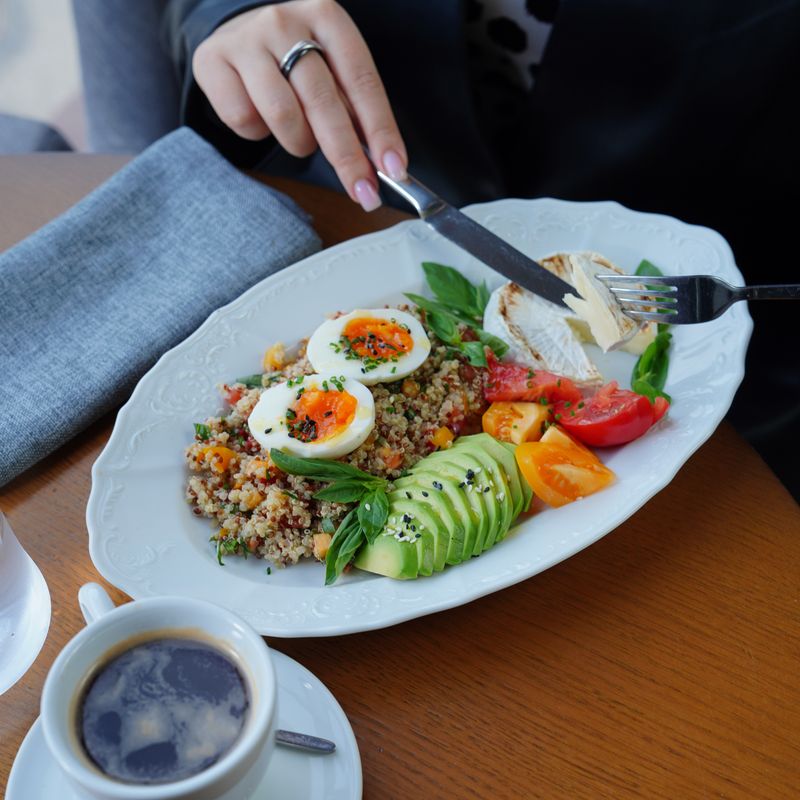
Breakfast Sausage and Egg Quinoa Casserole
A protein-packed, savory breakfast casserole featuring fluffy quinoa, seasoned breakfast sausage, eggs, sharp cheddar cheese, and sautéed onions in a creamy custard base. Bake once and enjoy for multiple meals—it reheats beautifully and is ideal for weeknight breakfasts or weekend brunches.
- Prep
- 20 min
- Cook
- 35 min
- Wait
- 25 min
- Total
- 1 hr 20 min
- Makes
- One 9×13-inch (23×33 cm) casserole (8 servings)
Steps
Before you start
- Preheat your oven to 350°F (175°C) about 10 minutes before you start cooking.
- Measure out all ingredients before you begin so assembly goes smoothly.
- Have a 9×13-inch (23×33 cm) baking dish ready and lightly buttered.
- Note that you'll be cooking quinoa while browning sausage—these overlap to save time.
Brown the sausage
- Heat a large skillet over medium-high heat.
- Add 1 lb breakfast sausage, breaking it into small ¼-inch crumbles with a wooden spoon as it cooks.
- Stir frequently until browned throughout and cooked with no pink remaining, 5–7 minutes.
- If excess fat has rendered and the sausage looks very greasy, drain most of it off, leaving about 1 tablespoon in the pan for flavor.
- Transfer the cooked sausage to a small bowl.
+ Show details− Hide details
Ready when: Sausage is browned throughout with no pink; internal temperature reaches 160°F (71°C)
Tip: Breaking sausage into small, uniform pieces ensures it cooks evenly and distributes throughout the casserole, rather than clumping.
Cook the quinoa
- While the sausage cooks, rinse 1.5 cups dry quinoa under cold running water in a fine-mesh strainer until the water runs completely clear (this removes bitter saponins).
- In a medium saucepan, bring 2.25 cups water to a boil over high heat.
- Add the rinsed quinoa, stir once, then reduce heat to low, cover with a tight-fitting lid, and simmer until all water is absorbed and the quinoa is tender with visible white spirals, about 15 minutes.
- Remove from heat and let rest covered for 5 minutes.
- Fluff gently with a fork.
+ Show details− Hide details
Ready when: Quinoa is tender, water is fully absorbed, grains are fluffy and show white spiral germs
Tip: Rinsing is essential—skipping it will leave a soapy, bitter flavor. Don't use a fine strainer or the grains will fall through.
Sauté the onion
- Add 1 tablespoon butter to the skillet with the cooked sausage (you can leave some of the rendered fat in the pan).
- Set heat to medium.
- Add 1 medium onion (about 150 g), diced into ¼-inch pieces, and cook, stirring occasionally, until softened and just beginning to turn golden at the edges, 3–4 minutes.
- The onion should be tender but not browned or caramelized—you want its natural sweetness.
+ Show details− Hide details
Ready when: Onion is soft, translucent, and just turning golden at the edges
Tip: Lower heat and stir frequently to prevent the onion from browning too quickly, which would make it bitter and lose its sweetness.
Mix the custard base
- In a large mixing bowl, crack 8 large eggs and beat them lightly with a whisk until uniform in color.
- Pour in 1.5 cups whole milk, 1 teaspoon kosher salt, ½ teaspoon black pepper, and ½ teaspoon smoked paprika (if using—it adds subtle depth).
- Whisk vigorously for 1 minute until the mixture is completely smooth and homogeneous with no visible streaks of egg white remaining.
+ Show details− Hide details
Ready when: Egg-milk mixture is smooth, uniform, and pale yellow with no visible streaks
Tip: Whisk thoroughly—any unmixed egg white will show as white flecks in the baked casserole and create uneven texture.
Assemble the casserole
- Butter a 9×13-inch (23×33 cm) baking dish with the remaining ½ tablespoon butter, coating the bottom and sides lightly.
- Spread the cooked quinoa in an even layer across the bottom of the dish, using a fork to break up any clumps gently.
- Distribute the cooked sausage and onion mixture evenly over the quinoa.
- Sprinkle 1.5 cups (150 g) of the shredded cheddar cheese over the sausage layer.
- Slowly pour the egg-milk custard over everything, tilting and gently rotating the dish to help the liquid settle evenly.
- Using a fork, gently stir the top layer without breaking apart the quinoa—you want the custard to seep down around all the ingredients.
- Top with the remaining ½ cup (50 g) shredded cheddar.
+ Show details− Hide details
Ready when: All ingredients are layered and custard is evenly distributed throughout
Tip: Stir gently to avoid mashing the quinoa; rough stirring makes the final casserole dense and mushy instead of light and fluffy.
Bake until setOven 350°F / 175°C
- Place the assembled casserole in the preheated oven and bake uncovered at 350°F (175°C) until the egg custard is set but still slightly jiggly in the very center when you gently shake the pan, the edges are pulling away slightly from the dish sides, and a knife inserted 1 inch from the center comes out clean (with no runny liquid), 30–35 minutes.
- The top should be light golden brown.
- An instant-read thermometer inserted in the center should read 160°F (71°C).
+ Show details− Hide details
Ready when: Custard is just set with a slight jiggle in the very center, edges pull away from pan sides, knife comes out clean, internal temperature 160°F (71°C), top is light golden brown
Tip: Start checking at 28 minutes—a slight jiggle in the very center signals perfect doneness and ensures the casserole stays creamy rather than drying out.
Rest before serving
- Remove the casserole from the oven and let it rest on the counter for 5–10 minutes without cutting into it.
- This allows the custard to set fully and the casserole to firm up, making it much easier to slice into neat portions without the filling falling apart.
+ Show details− Hide details
Tip: Skipping the rest period will result in a warm, loose casserole that falls apart when cut. The 10 minutes is worth it.
Good to know
Tips
- For the best light, fluffy texture, use freshly cooked quinoa rather than reheated leftovers, which tend to become dense and gummy.
- If your breakfast sausage is very fatty, drain off the excess after browning, but leave about 1 tablespoon of rendered fat in the pan for flavor—don't wash the pan.
- Stir very gently when incorporating the egg custard; aggressive stirring breaks apart the quinoa and creates a mushy, dense casserole instead of a light one.
- This casserole pairs beautifully with a simple green salad, fresh fruit (berries or citrus), or whole-grain toast to round out the meal.
Make ahead
Assemble the casserole (through Step 5) up to 8 hours in advance: cover tightly with plastic wrap and refrigerate. Bake from cold, adding 5–10 minutes to the baking time. Alternatively, prepare all components separately 1 day ahead (cook the quinoa, brown the sausage, dice the onion) and assemble when ready to bake.
Storage & reheating
Store covered in the refrigerator for up to 4 days. Reheat individual portions in the microwave on 50% power for 1–2 minutes, or reheat the whole casserole loosely covered with foil at 325°F (163°C) for 15–20 minutes until warmed through. Do not freeze; the egg custard will become grainy and separated upon thawing.
Substitutions
- breakfast sausage (loose or removed from casings) → Ground turkey sausage or Italian sausage (removed from casings). Ground turkey is leaner and has a milder flavor. Italian sausage adds herbs and more pronounced spice—choose sweet or spicy depending on preference.
- whole milk → Heavy cream or evaporated milk (use 1.25 cups evaporated). Heavy cream creates a richer, more decadent custard. Evaporated milk adds body and creaminess without excess fat.
- sharp cheddar cheese, shredded → Gruyère, Emmental, or a sharp American cheese blend. Gruyère brings nutty, caramel-like depth. American cheese melts very smoothly for a creamier texture. Emmental adds mild, slightly sweet flavor.
- yellow onion, medium → 2 cups diced bell peppers (red and yellow) or a mix of bell peppers and mushrooms. Bell peppers add sweetness and color; mushrooms add umami and earthiness. Cook for an extra 1–2 minutes as peppers take slightly longer to soften than onion.
More casseroles
See all →
Find more like this
- Cuisine
- American
- Quick & Easy
- Make Ahead