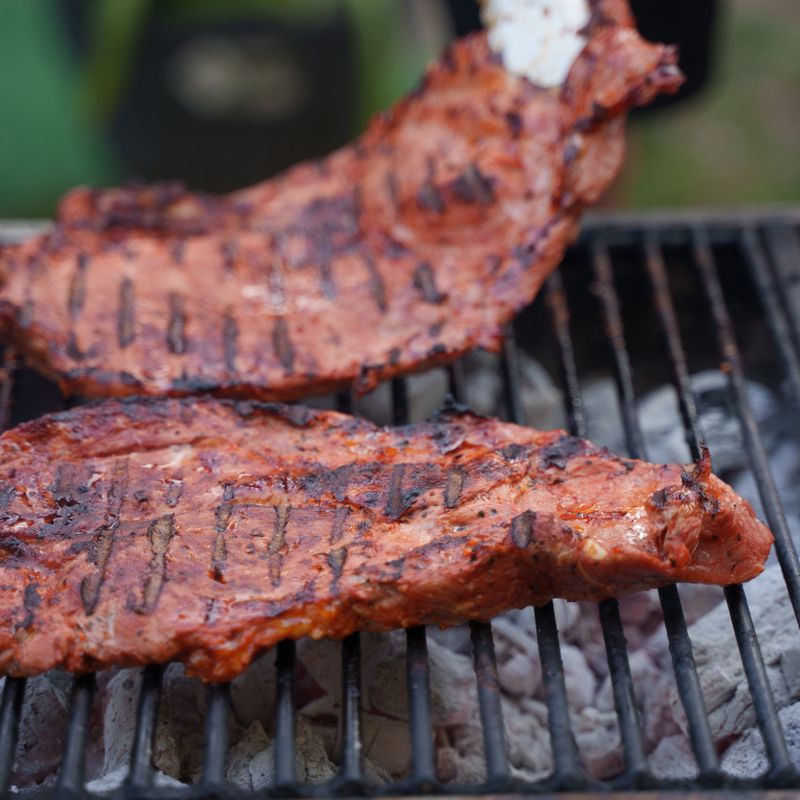
Barbecue Party Jerk Pork Ribs with Overnight Scotch Bonnet Marinade
Two racks of St. Louis-style ribs soak overnight in a fiery, fragrant jerk marinade of scotch bonnet, allspice, thyme and scallion, then are smoked low and slow, wrapped to tenderness and finished with a sticky honey-lime glaze. Built for feeding a crowd.
- Prep
- 45 min
- Cook
- 5 hr
- Wait
- 12 hr 30 min
- Total
- 18 hr 15 min
- Makes
- 2 racks of ribs (about 8 servings of 3–4 ribs each)
Steps
Before you start
- Start the day before: the ribs need a minimum of 12 hours (ideally 18–24) in the marinade, so plan to marinate the evening before.
- Scotch bonnets are very hot. Wear disposable gloves when cutting and handling them, and do not touch your eyes. Remove the seeds and white pith for a milder result.
- Buy St. Louis-style spareribs (about 2¾ lb / 1.25 kg per rack). If using baby back ribs, shorten the unwrapped smoke to 2 hours and the wrapped stage to 1 hour.
- Have 2 large 18-inch-wide sheets of heavy-duty foil per rack, plus a leave-in or instant-read thermometer ready.
- Allow about 18 hours from start to finish, with roughly 5 hours at the smoker the next day.
Trim and prep ribs
- Place each rack bone-side up on a rimmed baking sheet.
- Slide a butter knife under the thin, shiny membrane covering the bones at one end, lift it, then grip with a paper towel and pull it off in one piece (it may come in sections).
- Trim any large pieces of hard fat and loose flaps of meat.
- Pat the racks dry with paper towels.
+ Show details− Hide details
Ready when: Bone side feels meaty and bare with no slippery membrane left.
Tip: If the membrane is slippery, grip it with a dry paper towel for traction.
Blend the marinade
- Wearing gloves, add the scallions, scotch bonnets, onion, garlic, ginger, thyme, allspice, cinnamon, nutmeg, black pepper, salt, brown sugar, soy sauce, lime juice, cider vinegar and oil to a blender.
- Blend on high for 45–60 seconds, scraping down the sides once, until a thick, mostly smooth green-brown paste forms with only tiny flecks visible.
- You should have about 2 cups (480 ml).
+ Show details− Hide details
Ready when: Paste is thick and spoonable with no large chunks of scallion or pepper.
Tip: Open the blender lid away from your face; scotch bonnet fumes sting the eyes and nose.
Marinate overnight
- Cut each rack in half if needed to fit your bags.
- Divide the marinade between two 2-gallon zip-top bags, add the ribs, and massage the paste into all sides, including between the bones.
- Press out the air, seal, and lay flat on a rimmed tray in the refrigerator.
- Marinate for at least 12 hours and up to 24, flipping the bags once if you remember.
+ Show details− Hide details
Ready when: Ribs are fully coated in a deep green-brown paste and chilled through.
Tip: Do not go beyond 24 hours; the acid and salt can make the meat texture mushy.
Set up the smokerOven 250°F / 120°C
- About 1 hour before smoking, remove the ribs from the refrigerator.
- Prepare the smoker or grill for indirect cooking and heat to a steady 250°F (120°C), adding 3–4 chunks of hardwood.
- Lift the ribs from the bags and leave the clinging marinade on them; scrape off only thick clumps so the paste does not burn.
- Discard the bag marinade.
+ Show details− Hide details
Ready when: Smoker thermometer holds 250°F (120°C) for 10 minutes and smoke is thin and pale blue, not thick white.
Tip: Thick white smoke makes ribs bitter. Wait for it to thin before putting the meat in.
Smoke the ribsOven 250°F / 120°C
- Place the racks bone-side down on the smoker grate, not touching, away from direct heat.
- Close the lid and smoke at 250°F (120°C) for 3 hours, keeping the temperature between 240–260°F (115–125°C).
- Do not open the lid more than once or twice.
+ Show details− Hide details
Ready when: Surface is deep mahogany, the marinade is set and does not smear when touched, and the meat has pulled back slightly from the bone ends.
Tip: Add a fresh wood chunk only during the first 90 minutes; later smoke adds little flavor.
Wrap and braiseOven 250°F / 120°C
- Lay two overlapping sheets of heavy-duty foil for each rack.
- Place a rack meat-side up on each, then fold up the edges and pour 2 tbsp (30 ml) of apple juice around each rack.
- Seal the foil tightly into a packet.
- Return to the smoker and cook 1½ hours at 250°F (120°C).
+ Show details− Hide details
Ready when: Open a corner carefully: a probe slides between the bones with almost no resistance at around 195–203°F (90–95°C).
Tip: Open foil away from your face; hot steam escapes. Use two layers of foil to prevent tears and leaks.
Make the glaze
- While the ribs finish wrapping, whisk the honey, ketchup and glaze lime juice in a small saucepan.
- Set it over medium-low heat and simmer gently for 3 minutes, stirring, until slightly thickened and glossy.
- Remove from the heat.
+ Show details− Hide details
Ready when: Glaze coats the back of a spoon and a line drawn with your finger stays put.
Tip: Do not let it boil hard; honey scorches quickly.
Unwrap and glazeOven 250°F / 120°C
- Carefully remove the ribs from the foil and place them bone-side down directly on the grate; discard the foil and juices.
- Brush a thin layer of glaze over the top.
- Close the lid and cook 10 minutes, then brush on a second coat and cook 10 minutes more at 250°F (120°C), until the glaze is tacky and lacquered.
+ Show details− Hide details
Ready when: Glaze is sticky and glossy, the meat is probe-tender, and a rack bends easily and the surface cracks slightly when lifted with tongs from one end.
Tip: The ribs are very tender after braising; support them with two spatulas when moving them.
Rest and slice
- Transfer the racks to a cutting board, tent loosely with foil and rest 15 minutes so the juices settle.
- Slice between the bones with a sharp knife and pile onto a platter.
+ Show details− Hide details
Ready when: Ribs slice cleanly with the meat holding to the bone.
Tip: Cut with the bone side up so you can see exactly where the bones are.
Good to know
Tips
- Do not skip removing the membrane; it turns leathery and blocks the marinade from the bone side.
- Judge doneness by feel and probe, not time: a probe should slide in like softened butter between the bones.
- Cooking over a grill? Bank coals on one side, put the ribs on the other, and add fresh coals every hour to hold 250°F (120°C).
- Serve with extra glaze warmed on the side, plus rice and peas, grilled pineapple, and lime wedges to balance the heat.
Make ahead
"The marinade paste can be blended up to 3 days ahead and refrigerated in an airtight jar. The ribs can be fully smoked, cooled, and refrigerated up to 2 days before; reheat wrapped in foil at 300°F (150°C) for 25–30 minutes, then brush with warmed glaze."
Storage & reheating
Room temperature: up to 2 hours (1 hour if outdoors above 90°F / 32°C). Refrigerator: cool completely, wrap tightly and keep up to 4 days. Freezer: wrap in foil then a freezer bag for up to 3 months; thaw overnight in the fridge. Reheat wrapped in foil in a 300°F (150°C) oven for 20–30 minutes until hot (165°F / 74°C) throughout.
Substitutions
- scotch bonnet peppers → habanero peppers. Similar heat and fruitiness; use the same weight. For milder ribs, use 1 pepper, seeded.
- ground allspice → 1 tbsp ground allspice plus 1 tbsp extra thyme and ½ tsp ground clove. If you only have a small amount of allspice, this keeps the warm jerk character.
- St. Louis-style pork spareribs → baby back ribs (3 racks, about 2 lb each). Smoke unwrapped 2 hours, wrap 1 hour, glaze 20 minutes; they are done earlier than spareribs.
- honey → maple syrup or pineapple juice reduced to a syrup. Use equal amounts; pineapple adds a tropical tang.