Baked Penne with Roasted Vegetables and Ricotta
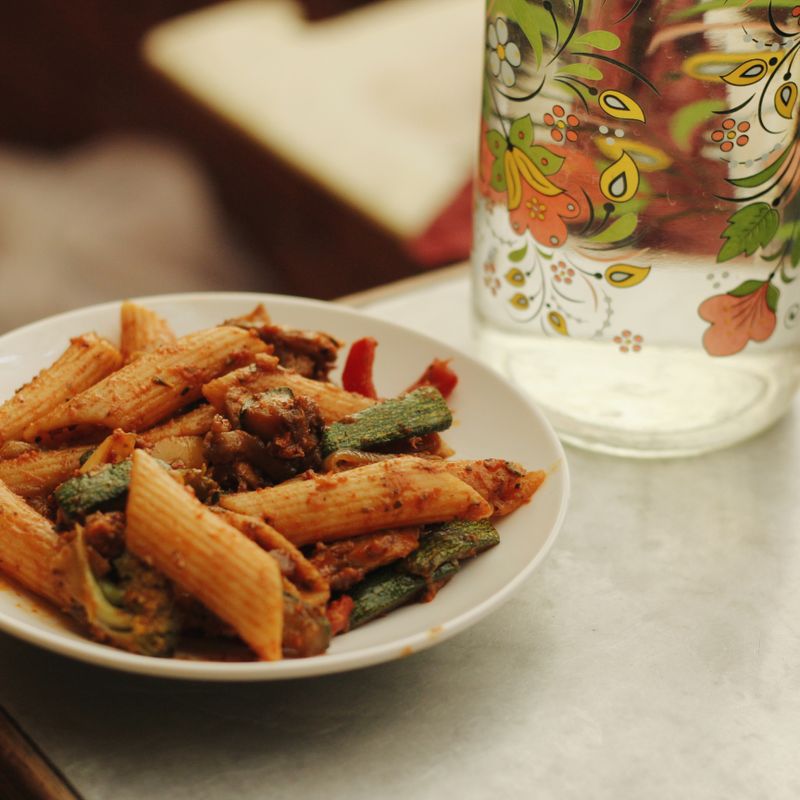
A rustic Italian-American baked pasta featuring al dente penne tossed with roasted seasonal vegetables, creamy ricotta, fresh mozzarella, and a light tomato sauce. The pasta bakes until golden and bubbly, creating a comforting main dish that's vegetarian, deeply flavorful, and perfect for weeknight dinners or entertaining.
- Prep
- 25 min
- Cook
- 50 min
- Wait
- 15 min
- Total
- 1 hr 30 min
- Makes
- 6 servings (one 9×13-inch baking dish)
Steps
Before you start
- Preheat oven to 425°F (220°C) for roasting vegetables at least 15 minutes before you begin
- Bring a large pot of salted water to a boil for the pasta
- Have a 9×13-inch (23×33 cm) baking dish ready and lightly oiled
Roast the vegetablesOven 425°F / 220°C
- Toss the zucchini, bell pepper, eggplant, and cherry tomatoes with 4 tablespoons (60 ml) olive oil, minced garlic, ½ teaspoon salt, and ¼ teaspoon black pepper on a large baking sheet.
- Spread in a single layer.
- Roast at 425°F (220°C) for 25–30 minutes, stirring halfway through, until the vegetables are golden brown at the edges and tender when pierced with a fork.
+ Show details− Hide details
Ready when: Vegetables are golden brown at edges and tender when pierced
Tip: Don't crowd the pan—arrange vegetables in a single layer for even browning; they won't roast properly if piled up.
Cook the penne
- While vegetables roast, bring a large pot of salted water to a boil.
- Add penne and cook according to package directions, usually 9–11 minutes, until al dente (pasta still has a slight firmness when bitten).
- Reserve 1 cup (240 ml) pasta water, then drain the pasta in a colander.
- Do not rinse.
+ Show details− Hide details
Ready when: Pasta is tender but still has slight firmness when bitten
Tip: Reserve pasta water—its starch helps bind the sauce and keeps the baked pasta moist.
Make the ricotta mixture
- In a medium bowl, whisk together the room-temperature ricotta, egg, ½ cup (50 g) grated Parmigiano-Reggiano, 2 tablespoons (30 ml) of the reserved pasta water, ¼ teaspoon salt, and a pinch of black pepper until smooth and combined.
- Set aside.
+ Show details− Hide details
Ready when: Mixture is smooth and creamy
Tip: Room-temperature ricotta whisks smoothly; cold ricotta will be lumpy and hard to combine.
Assemble the sauce base
- In a large bowl, combine the roasted vegetables (once cool enough to handle) with the crushed tomatoes, ¼ teaspoon red pepper flakes (if using), and ¼ teaspoon salt.
- Stir gently to combine.
- The mixture should look chunky and textured, not smooth.
+ Show details− Hide details
Ready when: All vegetables and sauce are evenly combined
Tip: Keep roasted vegetables slightly chunky—don't break them apart—for a rustic texture.
Combine pasta and sauce
- Add the drained penne to the large bowl with the vegetable-tomato mixture.
- Gently toss with a wooden spoon or pasta fork until evenly coated, adding 3–4 tablespoons (45–60 ml) reserved pasta water if the mixture seems dry.
- The pasta should be glossy and moist but not soupy.
+ Show details− Hide details
Ready when: Pasta is evenly coated and moist without being wet
Tip: Add pasta water gradually to keep the pasta from drying out during baking, but stop before it becomes soupy.
Layer in the baking dish
- Spoon half of the penne-vegetable mixture into a lightly oiled 9×13-inch (23×33 cm) baking dish.
- Drop spoonfuls of the ricotta mixture over the pasta layer, using about half of it, and gently spread without stirring through (leave some swirls).
- Top with half of the torn fresh mozzarella.
- Add the remaining penne-vegetable mixture and gently level the surface.
- Dollop the remaining ricotta mixture on top, leaving some pasta visible.
- Scatter the remaining mozzarella and the remaining ¼ cup (25 g) Parmigiano-Reggiano over the top.
+ Show details− Hide details
Ready when: Ingredients are layered with cheese on top
Tip: Don't stir the ricotta through—swirling it creates creamy pockets throughout the baked pasta.
Bake the pastaOven 375°F / 190°C
- Cover the baking dish loosely with aluminum foil (oil the underside so it doesn't stick to the cheese).
- Bake at 375°F (190°C) for 20 minutes.
- Remove the foil and bake for another 15–20 minutes until the cheese is melted and bubbly, the top is light golden, and the edges are slightly darker and crispy.
+ Show details− Hide details
Ready when: Cheese is melted and bubbly, top is light golden, edges are crispy
Tip: The foil prevents the top from browning too fast before the center heats through; remove it at the right time for a golden finish.
Rest and garnish
- Remove the baking dish from the oven and let it rest for 10–15 minutes before serving.
- This allows the sauce to set slightly and makes it easier to portion.
- Scatter the torn fresh basil over the top just before serving.
+ Show details− Hide details
Ready when: Resting is complete when dish has cooled enough to serve
Tip: Resting prevents the pasta from falling apart when you scoop it onto plates and gives the sauce time to thicken slightly.
Good to know
Tips
- Bring ricotta to room temperature at least 1 hour before cooking—this ensures it mixes smoothly into the filling and distributes evenly when layered.
- Taste the roasted vegetables before combining with the sauce; if they're under-seasoned, add a pinch more salt at that stage rather than trying to adjust after baking.
- For a lighter version, use half ricotta and half whole milk Greek yogurt to reduce fat while keeping the creamy texture.
- If your baking dish is shallow or you've filled it generously, place a baking sheet on the rack below to catch any drips and prevent oven mess.
Make ahead
Prepare the recipe through step 6 (layering in the baking dish) up to 4 hours ahead. Cover tightly with plastic wrap and refrigerate. Add 5–10 minutes to the covered baking time if baking straight from the cold. The unbaked casserole can also be frozen for up to 3 months; thaw overnight in the refrigerator before baking, adding 5 minutes to baking time.
Storage & reheating
Store leftovers in an airtight container in the refrigerator for up to 4 days. Reheat in a 350°F (175°C) oven, covered with foil, for 15–20 minutes until warmed through, or microwave individual portions at 50% power for 2–3 minutes. The casserole freezes well for up to 3 months; thaw overnight and reheat as above, adding 5–10 minutes.
Substitutions
- eggplant → mushrooms (cremini, button, or oyster). Use 1 medium (12 oz / 340 g), sliced or chunked. Mushrooms release more water, so don't stir the roasted vegetable mixture as much to avoid making the pasta soggy.
- whole milk ricotta cheese → whole milk yogurt or mascarpone. Use the same amount. Yogurt will be slightly tangier; mascarpone will be richer. Either will bind the pasta similarly.
- fresh mozzarella cheese → whole milk low-moisture mozzarella, shredded. Use 8 oz (225 g) shredded. It will melt evenly but won't create soft, creamy pockets like fresh mozzarella.
- crushed tomatoes (canned) → marinara sauce or tomato purée thinned with 2 tablespoons (30 ml) water. If using marinara, reduce added salt to ⅛ teaspoon since marinara is often seasoned. Purée will give a thicker, more concentrated flavor.