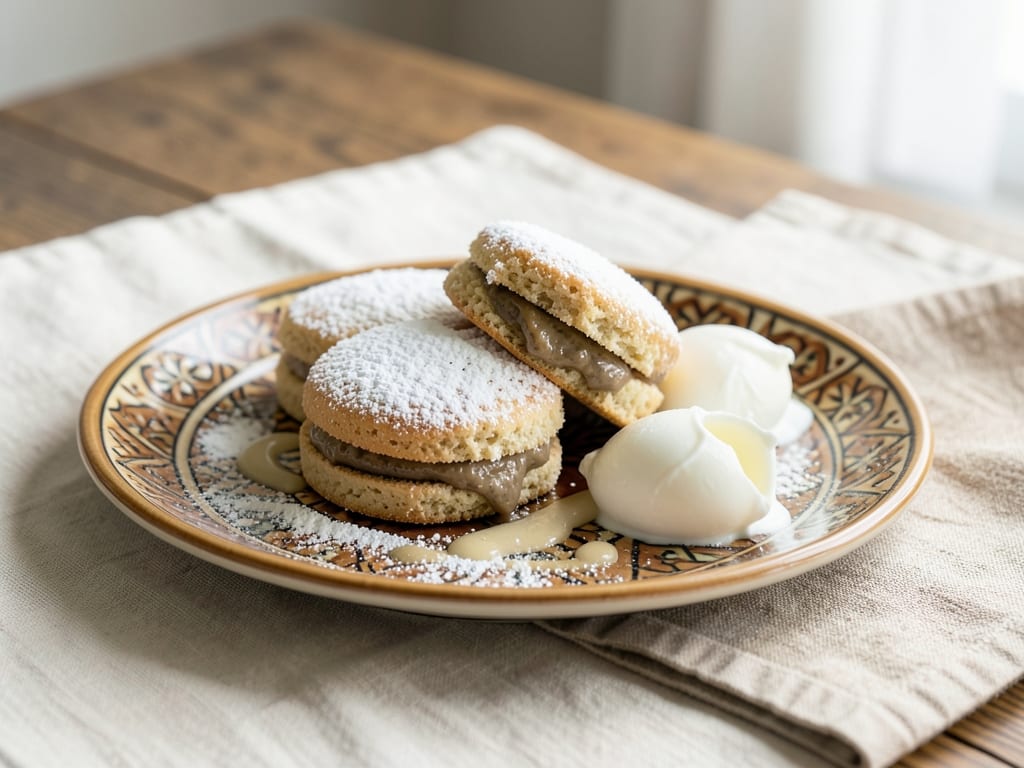
Alfajores with Tahini Dulce de Leche
Tender, melt-in-your-mouth shortbread cookies made with a high ratio of cornstarch, filled with silky tahini-infused dulce de leche, and dusted with powdered sugar. This fusion recipe combines the beloved Argentine tradition of alfajores with Middle Eastern tahini for a sophisticated, nutty flavor that elevates the classic treat.
- Prep
- 32 min
- Cook
- 13 min
- Wait
- 1 hr 5 min
- Total
- 1 hr 50 min
- Makes
- 12 sandwich cookies (24 individual cookies)
Steps
Before you start
- Soften unsalted butter to room temperature (about 1 hour before starting)
- Measure and prepare all ingredients (mise en place)
- Line two 9×13-inch (23×33 cm) baking sheets with parchment paper
- Preheat oven to 325°F (163°C) when you're ready to bake the cookies
Prepare oven and equipmentOven 325°F / 165°C
- Preheat oven to 325°F (163°C).
- Line two 9×13-inch (23×33 cm) baking sheets with parchment paper and set aside.
Cream butter and sugar
- In a medium mixing bowl, beat softened unsalted butter and granulated sugar together with an electric mixer on medium-high speed until pale, fluffy, and light in color, about 3–4 minutes.
- Stop halfway through to scrape down the sides of the bowl.
+ Show details− Hide details
Ready when: Mixture is pale and noticeably fluffier, increased by about one-third in volume
Tip: Don't skip this step—creaming incorporates air and creates lighter, more tender cookies
Add eggs and vanilla
- With the mixer on medium speed, add eggs one at a time, beating well after each addition (about 30 seconds per egg).
- Add vanilla extract and beat for another 30 seconds until fully incorporated.
+ Show details− Hide details
Ready when: Mixture is smooth and homogeneous
Tip: Adding eggs slowly prevents the mixture from breaking or becoming grainy
Combine dry ingredients
- In a separate bowl, whisk together all-purpose flour, cornstarch, baking powder, and salt until evenly distributed.
- This prevents lumps in the final dough.
+ Show details− Hide details
Ready when: All ingredients are evenly combined with no visible clumps
Fold wet and dry together
- Add the dry mixture to the wet mixture in three additions, folding gently with a rubber spatula after each addition until just combined.
- Stop as soon as no streaks of flour are visible.
- Do not overmix.
+ Show details− Hide details
Ready when: Dough is smooth and combined with no visible dry flour streaks
Tip: Overmixing toughens the dough; gently fold rather than stir vigorously
Chill dough
- Wrap the dough tightly in plastic wrap and refrigerate for 20 minutes until firm and easier to handle.
+ Show details− Hide details
Tip: Cold dough is much less sticky and easier to work with
Roll and cut cookies
- Lightly flour a work surface.
- Remove half the dough from the refrigerator and roll it out to 1/4-inch (6 mm) thickness.
- Using a 1.5-inch (4 cm) round cookie cutter dipped lightly in flour to prevent sticking, cut out 12 rounds.
- Place them on a prepared baking sheet, spacing them 1 inch (2.5 cm) apart.
- Repeat with the remaining dough on the second sheet.
- You should have 24 cookie rounds total.
+ Show details− Hide details
Ready when: 24 even, round cookies are cut and arranged on baking sheets
Tip: Dip the cutter in flour between cuts to prevent sticking and dragging the dough
Bake cookiesOven 325°F / 165°C
- Bake at 325°F (163°C) for 12–15 minutes until the edges are just barely golden and the tops are set but still pale or very lightly golden.
- The cookies will continue to cook slightly as they cool.
+ Show details− Hide details
Ready when: Edges are just barely golden, tops are set but pale; a toothpick inserted in the center comes out clean
Tip: Baking at a lower temperature prevents over-browning before the inside is cooked through
Cool cookies
- Remove from the oven and let cookies cool on the baking sheet for 5 minutes, then carefully transfer them to a wire cooling rack to finish cooling completely, about 15 more minutes.
+ Show details− Hide details
Ready when: Cookies are completely cool to the touch and set
Tip: Waiting 5 minutes on the sheet before transferring prevents them from breaking
Prepare tahini dulce de leche
- While cookies cool, pour tahini into a small saucepan and warm gently over medium-low heat, stirring constantly for 1–2 minutes until it loosens and becomes more pourable.
- Remove from heat and stir in dulce de leche, honey, and salt until completely smooth and well combined.
- Let cool to room temperature (about 10 minutes), then refrigerate for 20–30 minutes until the mixture thickens to a spreadable, frosting-like consistency.
+ Show details− Hide details
Ready when: Filling is smooth, fully combined, and thickened enough to spread without running
Tip: Warming the tahini first prevents lumps; if the filling is still too thin after chilling, add another tablespoon of tahini
Assemble alfajores
- Once cookies are completely cool and filling has set, lay out 12 cookie halves with flat sides facing up.
- Spread or pipe about 1/2 tablespoon (12–15 g) of tahini dulce de leche filling onto each of these 12 cookies.
- Top each with another cookie, flat side down, pressing gently so the filling just reaches the edges but doesn't bulge out dramatically.
+ Show details− Hide details
Ready when: 12 sandwich cookies are assembled with even filling layers
Tip: Match similar-sized cookie pairs for a professional appearance
Dust with powdered sugar
- Just before serving, dust the top and sides of each alfajor generously with powdered sugar using a fine sieve or mesh strainer for even coverage.
+ Show details− Hide details
Ready when: All alfajores are evenly coated with a generous layer of powdered sugar
Tip: Dust just before serving to keep the powder from absorbing moisture from the filling
Good to know
Tips
- The cornstarch is essential to alfajores' signature melt-in-your-mouth texture—do not reduce it or omit it. The ratio of cornstarch to flour creates delicate, tender cookies that would be tough without it.
- Keep all ingredients and equipment cool before mixing. Chill the dough before rolling for easier handling and cleaner cookie edges. The tahini filling must chill before assembly or it will be too thin to hold the sandwich together.
- If the tahini dulce de leche is too thick to spread after chilling, warm it for 30 seconds over low heat and stir until pourable. If it's too thin, refrigerate it longer or stir in another tablespoon of tahini.
- These cookies are best served at room temperature or chilled. The tahini filling is firmer and more stable when cold, and the powdered sugar won't absorb excess moisture as quickly.
Make ahead
Bake the cookies up to 3 days ahead and store in an airtight container at room temperature. Prepare the tahini dulce de leche filling up to 1 day ahead and refrigerate. Assemble alfajores up to 1 day before serving for best freshness, then dust with powdered sugar shortly before eating.
Storage & reheating
Room temperature: In an airtight container for 1 day (filling softens slightly). Refrigerator: In an airtight container for up to 3 days (filling remains stable). Freezer: Unfilled baked cookies freeze well for up to 1 month; thaw at room temperature for 30 minutes before assembling. Assembled alfajores do not freeze well due to the filling's texture changes. Reheat cooled cookies briefly (5 minutes at 300°F) if you prefer them warm.
Substitutions
- tahini (sesame seed paste) → Sunflower seed butter or finely ground sesame powder mixed with 1 tablespoon sesame oil. Use the same amount; this creates a milder, less nutty flavor profile
- dulce de leche → Homemade dulce de leche made by slowly cooking a can of sweetened condensed milk for 2–3 hours in simmering water. Homemade version is richer and less sweet than store-bought; use the same amount
- cornstarch → Tapioca starch or potato starch in the same amount for a slightly different but equally tender texture. These create a more delicate crumb; the cookies may spread slightly more
- all-purpose flour → Cake flour in the same amount for a more delicate, finer-crumbed texture. Cake flour is lower in protein, resulting in slightly more tender cookies
More cookies
See all →

Find more like this
- Meal
- Dessert
- Diet
- VegetarianHalal
- Method
- Oven