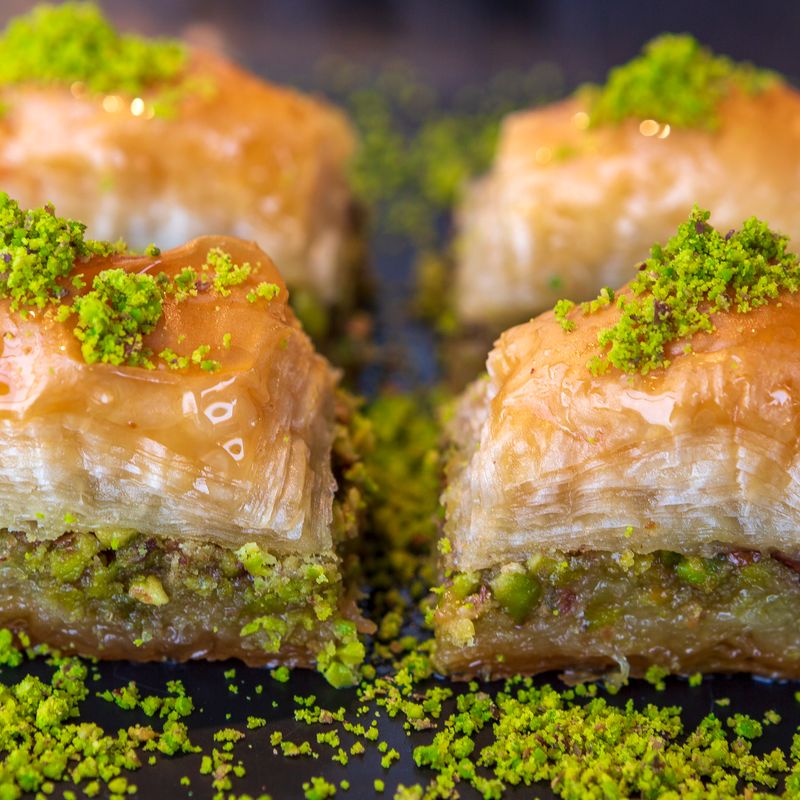
Pistachio Baklava with Honey Syrup
Crisp, shatteringly flaky layers of buttered phyllo wrapped around a spiced pistachio filling, soaked in a lemony honey syrup. This 9×13-inch pan makes 24 generous pieces and gets better after a long rest.
- Prep
- 1 hr 5 min
- Cook
- 1 hr
- Wait
- 4 hr
- Total
- 6 hr 5 min
- Makes
- 1 pan (24 pieces)
Steps
Before you start
- Thaw the phyllo in its unopened package in the refrigerator for 24 hours. Then leave it on the counter, still sealed, for 1 hour before using. Phyllo thawed too quickly turns gummy and tears.
- Plan on at least 4 hours of resting after baking. The syrup needs that time to soak in and the pastry needs it to crisp. Overnight is even better.
- Make the syrup first so it is cool when the baklava comes out of the oven. Hot pastry plus cool syrup is what keeps the layers crisp.
- Have a damp (not wet) kitchen towel and plastic wrap ready to cover the phyllo while you work.
Make the syrup
- In a medium saucepan, combine the syrup sugar, water, honey, lemon juice and lemon peel.
- Stir over medium heat until the sugar dissolves, then bring to a boil.
- Reduce to medium-low and simmer gently, without stirring, for 10 minutes.
- Remove from the heat, discard the peel, and stir in the rose water if using.
- Set aside to cool to room temperature while you assemble the baklava.
+ Show details− Hide details
Ready when: The syrup is slightly thickened and coats the back of a spoon but still pours easily. It will thicken more as it cools.
Tip: Don't stir once it boils. Stirring can make the sugar crystallize.
Clarify the butter
- Melt the butter in a small saucepan over medium-low heat.
- Let it sit off the heat for 2 minutes, then skim the white foam from the surface with a spoon.
- Keep the butter warm and liquid.
- Leave the milky solids at the bottom of the pan behind if you can.
+ Show details− Hide details
Ready when: The butter is completely melted and the surface is clear and golden.
Tip: Skimming the foam gives crisper, less greasy layers.
Prep pan and phylloOven 350°F / 175°C
- Heat the oven to 350°F (175°C) with a rack in the center.
- Brush the bottom and sides of a 9×13-inch (23×33 cm) pan with melted butter.
- Unroll the phyllo and stack the sheets.
- Cut the whole stack in half crosswise with a sharp knife to make two stacks of about 9×14-inch (23×35 cm) pieces.
- Trim to fit the pan if needed.
- Cover the stacks with plastic wrap and a damp towel.
+ Show details− Hide details
Ready when: The sheets fit the pan with no more than ½ inch (1 cm) of overhang.
Tip: Keep the phyllo covered at all times. Uncovered sheets dry out and crack within minutes.
Mix the filling
- Stir the chopped pistachios with the filling sugar, cinnamon and salt in a bowl until evenly combined.
- Pulse in a food processor in short bursts, or chop by hand, so the nuts are coarse and not powdery.
+ Show details− Hide details
Ready when: The nuts look like coarse crumbs with a few small pieces still visible, with no large chunks.
Tip: Over-processing releases the nut oils and makes a paste, which gives a dense baklava.
Layer the bottom
- Lay one phyllo half-sheet in the pan and brush it lightly all over with butter, going out to the edges.
- Repeat with 19 more half-sheets, 20 in total, brushing each one with butter.
- Use about 1 teaspoon of butter per sheet.
- Press out any large air bubbles gently with your palm.
- If a sheet tears, patch it with the next one.
- Don't worry about small tears in the middle layers.
+ Show details− Hide details
Ready when: The stack of 20 buttered layers is even and covers the entire pan bottom, with no dry spots.
Tip: Work steadily but don't rush. A thin, even coat of butter matters more than speed.
Add filling and top layers
- Spread the pistachio mixture evenly over the bottom layers and press it lightly flat with the back of a spoon.
- Cover with a half-sheet of phyllo, brush with butter, and repeat until all the remaining 20 half-sheets are used.
- Brush the top layer generously with all the remaining butter.
+ Show details− Hide details
Ready when: The filling is an even layer about ½ inch (1 cm) thick, and the top is glossy with butter.
Tip: Press the top gently to compact the layers. A loose stack bakes up uneven.
Cut before baking
- With a long, very sharp knife, cut all the way through to the bottom of the pan.
- Cut lengthwise into 4 equal strips, then crosswise into 6 equal pieces to make 24 rectangles.
- For diamonds, cut diagonally instead.
- Use a gentle sawing motion so the layers don't shred.
+ Show details− Hide details
Ready when: Every cut reaches the pan bottom, so the pieces are fully separated.
Tip: Cutting before baking is essential. Baked phyllo shatters when cut and the syrup can't reach the bottom layers.
Bake until goldenOven 350°F / 175°C
- Bake in the 350°F (175°C) oven for 45 to 50 minutes, rotating the pan once halfway, until the top is deep golden brown and the edges are crisp and pulling away slightly from the pan.
- Check at 40 minutes.
- If the top browns too fast, tent loosely with foil.
+ Show details− Hide details
Ready when: The top is deep golden brown and the layers puff and look crisp. The edges are dark gold and sizzling.
Tip: Pale baklava turns soggy after the syrup goes on, so bake to a deep golden color.
Pour syrup over hot baklava
- Remove the pan from the oven and place it on a heatproof surface.
- Right away, slowly spoon the cooled syrup evenly over the hot baklava, especially along the cut lines.
- It should sizzle.
- Sprinkle the center of each piece with the ground pistachios.
+ Show details− Hide details
Ready when: The syrup sizzles on contact and is absorbed into the layers, leaving only a thin glossy film on top.
Tip: The pastry must be hot and the syrup cool. If both are hot, the baklava turns soggy.
Rest before serving
- Leave the baklava uncovered at room temperature for at least 4 hours, or overnight, so the syrup is absorbed and the layers set.
- Re-cut along the lines if needed and lift out the pieces with a small offset spatula.
+ Show details− Hide details
Ready when: The pieces lift out cleanly, and the pastry is crisp on top and moist but not wet inside.
Tip: Don't cover it while it rests. Trapped steam softens the crisp top layers.
Good to know
Tips
- Use a very sharp knife and a sawing motion for cutting. A dull blade drags and tears the top layers.
- If phyllo sheets stick together or crack, they were thawed too fast or dried out. Keep the stack covered with a damp towel and work quickly.
- Cool syrup on hot pastry is the key to crispness. If you forget to make the syrup first, cool it in the refrigerator for 15 minutes before pouring.
- Use the lowest oven rack position if the bottom layers look pale after 30 minutes. Dark metal pans bake more evenly than glass.
Make ahead
Baklava is best made 1 day ahead. Bake, syrup and rest it overnight at room temperature, uncovered for the first 4 hours, then loosely covered.
Storage & reheating
Room temperature: keep loosely covered (foil or a container with a cracked lid) for up to 5 days. Don't refrigerate, as it makes the pastry hard and soggy. Freezer: freeze cut pieces in a single layer until firm, then layer between parchment in an airtight container for up to 2 months. Thaw at room temperature for 2 hours. To re-crisp, warm on a baking sheet at 300°F (150°C) for 5 to 8 minutes and cool before serving.
Substitutions
- raw unsalted shelled pistachios → walnuts or a mix of walnuts and almonds. Use the same weight. Walnuts give a more traditional Greek-style baklava with a slightly more bitter flavor.
- unsalted butter → ghee. Use the same amount. Ghee needs no clarifying and gives a nutty flavor.
- honey → light corn syrup or more sugar syrup. Use the same amount. The flavor will be less floral, but the texture of the syrup is the same.
- rose water → orange blossom water. Use the same amount, or leave it out. Both are floral and strong, so don't add more.
More middle eastern sweets
See all →
Find more like this
- Meal
- Dessert
- Cuisine
- Turkish
- Diet
- VegetarianHalal
- Method
- Oven
- Quick & Easy
- Make Ahead