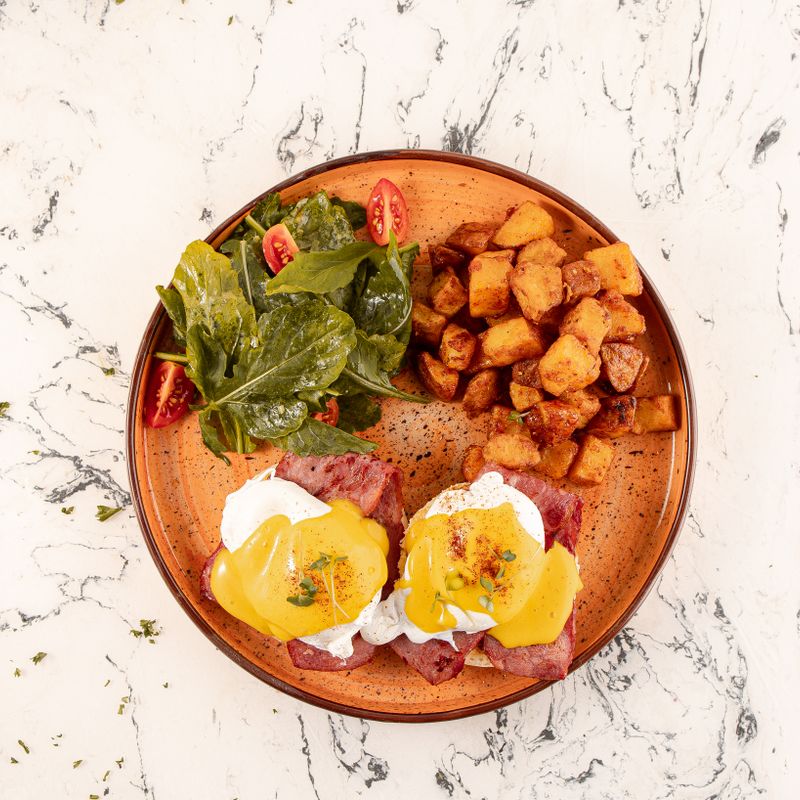
Classic Eggs Benedict
Toasted English muffins topped with seared Canadian bacon, tender poached eggs with runny yolks, and a warm, lemony hollandaise made by hand over a gentle double boiler.
- Prep
- 20 min
- Cook
- 25 min
- Wait
- 5 min
- Total
- 50 min
- Makes
- 8 open-faced halves (4 servings of 2 halves each)
Steps
Before you start
- Eggs Benedict comes together quickly at the end, so have every ingredient measured and every tool out before turning on a burner.
- Use the freshest eggs you can find. Fresh whites hold tight around the yolk, which gives neat poached eggs.
- Hollandaise contains gently cooked yolks. Heat them to 160°F (71°C) for safety, and consider pasteurized eggs for anyone pregnant, elderly, or immunocompromised.
- Crack each poaching egg into its own small cup or ramekin before you start so they slide into the water together.
Set up your station
- Crack the 8 eggs one at a time into 8 small cups or ramekins, keeping the yolks whole.
- Split the English muffins with a fork and set them by the toaster or skillet.
- Separate the 4 egg yolks into the heatproof bowl and set the whites aside for another use.
- Line a plate with a towel for draining the poached eggs, and put a second plate beside the stove for the toasted muffins.
- Pour about 1 inch (2.5 cm) of water into the medium saucepan for the double boiler.
+ Show details− Hide details
Ready when: Everything is within arm's reach and the eggs are in their cups.
Tip: Peering for eggshell after the fact is stressful, so crack carefully and fish out any bits now.
Melt the butter
- Put the 12 tablespoons (170 g) butter for the hollandaise in the small saucepan over medium-low heat.
- Warm it until completely melted and hot but not browning, about 3 minutes.
- Pour it into a small measuring cup with a spout and keep it warm near the stove.
+ Show details− Hide details
Ready when: Butter is fully liquid, hot to the touch of the pan, and has not browned.
Tip: Hot butter emulsifies more easily than lukewarm butter, so don't let it cool.
Heat the poaching water
- Pour the 6 cups (1.4 L) poaching water into the large skillet or wide saucepan, which should be at least 2½ inches (6 cm) deep.
- Add the 1 tablespoon white vinegar.
- Bring to a bare simmer over medium heat, with small bubbles clinging to the bottom and the surface just trembling, about 5 minutes.
- Then reduce the heat to medium-low to hold it there.
- At the same time, bring the double-boiler water to a bare simmer over low heat.
+ Show details− Hide details
Ready when: Surface trembles with a few tiny bubbles rising; no rolling boil.
Tip: A rolling boil shreds the whites. If the water boils, lower the heat and wait a minute.
Whisk the hollandaise base
- Add the 1½ tablespoons lemon juice and 1 tablespoon water to the yolks.
- Set the bowl over the barely simmering double-boiler water, making sure the bottom of the bowl doesn't touch the water.
- Whisk constantly for 3 to 4 minutes, until the yolks turn pale, thicken, and leave visible ribbon trails on the surface.
- An instant-read thermometer should read 160°F (71°C).
- Lift the bowl off the heat now and then if it starts to feel hot to the touch.
+ Show details− Hide details
Ready when: Mixture is pale yellow, doubled in volume, and falls from the whisk in thick ribbons at 160°F (71°C).
Tip: If the yolks start to look grainy or scrambled, immediately pull the bowl off the heat and whisk in 1 tablespoon cold water.
Emulsify with butter
- Remove the bowl from the saucepan and set it on a folded towel so it doesn't slide.
- Whisking constantly, add the hot melted butter a few drops at a time, then in a very thin stream once the sauce starts to thicken.
- Leave behind the milky white solids at the bottom of the cup, which can make the sauce taste heavy.
- Whisk in the salt and cayenne.
- Taste and add a few more drops of lemon juice or a pinch of salt if needed.
- Keep the sauce warm by setting the bowl over the pot of hot (not simmering) water with the burner off, whisking occasionally.
+ Show details− Hide details
Ready when: Sauce is thick, smooth, glossy, and coats the back of a spoon; it should pour in a slow ribbon.
Tip: If the sauce splits, whisk 1 tablespoon hot water in a clean bowl, then slowly whisk the broken sauce into it.
Brown the Canadian bacon
- Melt the 1 tablespoon butter in the 12-inch (30 cm) skillet over medium-high heat.
- Add the Canadian bacon in a single layer, working in two batches if needed.
- Cook 1 to 2 minutes per side, until the edges curl slightly and the surface is lightly browned in spots.
- Transfer to a plate and cover loosely with foil to keep warm.
+ Show details− Hide details
Ready when: Slices are hot through, with golden brown spots on both sides.
Tip: Leave the skillet unwashed; the leftover butter and drippings toast the muffins with extra flavor.
Toast the muffins
- Place the muffin halves cut-side down in the same skillet over medium heat.
- Toast for 2 to 3 minutes until deeply golden and crisp on the cut surface.
- Arrange 2 halves, cut side up, on each of 4 warm plates.
+ Show details− Hide details
Ready when: Cut surfaces are deep golden brown and crisp to the touch.
Tip: Toasting them crisp keeps the muffin from turning soggy under the egg and sauce.
Poach the eggs
- Make sure the poaching water is at a bare simmer.
- Tip the cups close to the surface and slide the eggs in gently, 4 at a time, working in two batches.
- Cook for 3 to 4 minutes, until the whites are opaque and set but the yolks still jiggle when nudged.
- Lift each egg out with a slotted spoon, rest it on the towel for a few seconds to drain, and trim off any ragged whites with kitchen scissors if you like.
+ Show details− Hide details
Ready when: Whites are completely opaque and firm; yolks wobble and feel soft when gently pressed.
Tip: Don't stir the water. Dropping eggs in slowly and close to the surface helps the whites wrap around the yolks.
Assemble and serve
- Set one slice of Canadian bacon on each muffin half.
- Top each with a drained poached egg.
- Whisk the hollandaise once more, loosening it with a teaspoon of warm water if it has thickened, then spoon about 3 tablespoons over each egg.
- Sprinkle with chives, if using, and serve right away.
+ Show details− Hide details
Ready when: Sauce lightly coats each egg and runs down the sides; yolks break open when cut.
Tip: Serve immediately. Poached eggs cool fast and the hollandaise thickens as it sits.
Good to know
Tips
- Keep the double-boiler water at a bare simmer. Too much heat scrambles the yolks quickly.
- If your pan is large enough, poach no more than 4 eggs at a time so the water temperature stays steady.
- Strain the egg whites through a fine mesh sieve in a bowl for 30 seconds before poaching to remove the watery outer white, which cuts down on wispy strands.
- Season the hollandaise at the end: lemon and salt change flavor quickly and are easy to overdo early.
Make ahead
"Poached eggs can be made up to 2 days ahead: transfer them with a slotted spoon to a bowl of ice water, refrigerate, then reheat in hot (not boiling) water for 60 seconds before serving. Hollandaise is best fresh, but it can be held for up to 1 hour in a warmed insulated thermos."
Storage & reheating
"Best eaten immediately. Assembled Benedicts do not store well. Refrigerate leftover hollandaise in an airtight container for up to 2 days and reheat gently in a bowl set over barely simmering water, whisking in a teaspoon of warm water, or in the microwave at 10-second bursts at 30% power while stirring. Do not freeze hollandaise. Poached eggs keep refrigerated in water for 2 days. Cooked Canadian bacon keeps 4 days in the fridge."
Substitutions
- Canadian bacon slices → thin slices of ham, smoked salmon, or sautéed spinach. Ham needs only a quick warm-through; smoked salmon and spinach need no cooking beyond wilting the spinach, for a Florentine-style version.
- fresh lemon juice → white wine vinegar. Use 1 tablespoon for a sharper, more traditional tang.
- English muffins → thick-sliced brioche or sourdough, toasted. Cut into rounds or leave whole; toast until crisp so it holds up to the egg.
- unsalted butter → ghee. Clarified butter gives a very smooth, stable sauce, but use the same weight and warm it the same way.