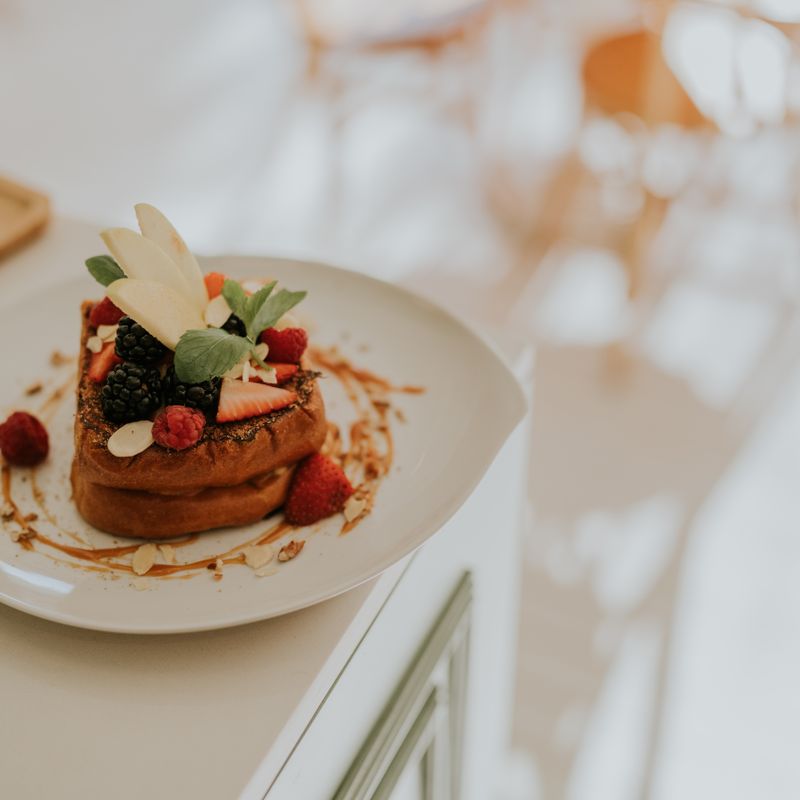
Cinnamon Swirl French Toast Bake
Toasted brioche cubes are layered with a buttery brown sugar–cinnamon swirl and soaked in vanilla custard, ideally overnight. The bake goes into the oven covered so the custard sets gently. A crunchy streusel goes on for the uncovered stage so it stays crisp. It's a make-ahead breakfast with a custardy middle and a crisp top.
- Prep
- 47 min
- Cook
- 1 hr 10 min
- Wait
- 1 hr 50 min
- Total
- 3 hr 47 min
- Makes
- 1 (9×13-inch) bake, 10 generous servings
Steps
Before you start
- Use day-old brioche if you can. Fresh bread is fine, because you toast the cubes in step 2 to dry them.
- The bake needs at least 1 hour to soak and tastes best soaked 8–12 hours in the fridge. For an overnight soak, do steps 1–6 the day before.
- Make the streusel (step 7) while the bake soaks, or the morning of baking, and keep it chilled in a covered container. It goes on the bake only after the covered bake, not before.
- Plan for a total oven time of 55–70 minutes after the dish comes out of the fridge. The 160°F (71°C) center temperature is the final cue, not the clock.
- Cut the streusel butter into cubes and keep it in the fridge until you need it.
Prep dish and bread
- Place oven racks in the upper and lower thirds and heat the oven to 300°F (150°C).
- Rub the 1 tbsp softened butter over the bottom and sides of a 9×13-inch (23×33 cm) baking dish.
- Cut the brioche into 1-inch (2.5 cm) cubes, leaving the crusts on, and spread the cubes across two rimmed baking sheets in a single layer.
- You should have about 8–9 cups.
+ Show details− Hide details
Ready when: Cubes are an even size and the dish is evenly coated with butter.
Tip: Cut the cubes the same size so they soak up the custard evenly.
Toast the breadOven 300°F / 150°C
- Bake the cubes at 300°F (150°C), swapping the sheets between racks and stirring once halfway, for 10 minutes.
- This dries the outsides so the bread holds its shape instead of turning mushy in the custard.
+ Show details− Hide details
Ready when: Cubes feel dry and slightly firm on the outside with only a hint of color. They should not be browned.
Tip: Fresh bread needs the full 10 minutes. Bread that is already stale can come out at 6–8.
Cool and mix cinnamon butter
- Take the cubes out and let them cool on the sheets for 10 minutes.
- While they cool, stir the melted butter, ⅓ cup brown sugar, and 1 tbsp cinnamon in a small bowl into a thick, damp paste with no dry pockets of sugar.
- Turn the oven off for now.
+ Show details− Hide details
Ready when: Paste looks like wet sand and holds together when pressed with a spoon, and the cubes are no longer warm to the touch.
Tip: If the paste is too stiff to drizzle, warm it for 5–10 seconds in the microwave.
Whisk the custard
- In a large bowl, whisk the eggs, ¼ cup brown sugar, vanilla, 1 tsp cinnamon, and ½ tsp salt for about 1 minute until the sugar dissolves and no streaks of egg white remain.
- Whisk in the milk and cream until smooth.
- You will have about 4 cups of custard.
+ Show details− Hide details
Ready when: Custard is uniformly pale tan and thin, with no visible egg white or sugar granules.
Tip: Whisk the eggs well before adding the milk. Streaks of egg white bake into rubbery bits.
Layer the swirl
- Spread half the cooled cubes (about 4 cups) in the buttered dish.
- Drizzle about half of the cinnamon butter over them in thin lines, then top with the remaining cubes.
- Drizzle the rest of the cinnamon butter in zigzag lines.
- Drag a butter knife through the top layer a few times to make swirls.
+ Show details− Hide details
Ready when: Cubes fill the dish in a fairly even layer that sits below the rim, with ribbons of cinnamon paste visible on top.
Tip: Don't mix the cinnamon paste in completely. Pockets of cinnamon give you the swirl.
Pour and soak
- Pour the custard slowly and evenly over the bread, in 2–3 additions, pausing so it can sink in.
- Press the cubes down gently with a spatula so every piece touches liquid.
- Cover the dish tightly with plastic wrap or foil and refrigerate for at least 1 hour, or up to 12 hours overnight.
+ Show details− Hide details
Ready when: Most of the liquid is absorbed, with only a small pool at the bottom of the dish after pressing, and the liquid sits below the rim.
Tip: Press the cubes down again halfway through the soak if you can. Any dry cubes on top will bake up hard.
Make the streusel
- While the bake soaks, or the morning you bake it, stir the flour, ⅓ cup brown sugar, ½ tsp cinnamon, and ⅛ tsp salt in a medium bowl.
- Add the cold butter cubes and rub them in with your fingertips, pinching, until the mixture forms clumps the size of peas and small crumbs.
- Stir in the pecans if using.
- Cover and refrigerate until step 10.
- Do not put it on the bake yet.
+ Show details− Hide details
Ready when: Mixture looks like coarse, clumpy crumbs and holds together when squeezed.
Tip: Keep the butter cold. If it softens and the mixture looks greasy, chill the bowl for 10 minutes.
Preheat and temperOven 350°F / 175°C
- Take the dish out of the fridge and set it on the counter for 30 minutes.
- At the same time, heat the oven to 350°F (175°C) with a rack in the center.
- Set the dish on a rimmed baking sheet to catch any drips.
- Remove the plastic wrap, press down any cubes that have popped up, and cover the dish tightly with foil.
- The streusel is not on the bake at this stage.
+ Show details− Hide details
Ready when: The dish is no longer ice-cold on the bottom and the oven has reached 350°F (175°C).
Tip: Use a baking sheet under the dish. A full dish can bubble over at the edges.
Bake coveredOven 350°F / 175°C
- Bake the foil-covered dish at 350°F (175°C) for 35 minutes.
- Trapping steam this way lets the custard set gently without the top browning too fast.
+ Show details− Hide details
Ready when: Edges are puffed and the custard looks mostly set, with a slight jiggle in the very center.
Tip: If the center still looks very wet and sloshy at 35 minutes, re-cover and give it another 5–10 minutes before adding the streusel.
Add streusel and bakeOven 350°F / 175°C
- Remove the foil and scatter the chilled streusel evenly over the top.
- Bake uncovered at 350°F (175°C) for 20–30 minutes more, until the streusel is deep golden and crisp.
- The total oven time will be about 55–70 minutes.
- Push an instant-read thermometer into the center to check that it reads 160°F (71°C), and that a knife comes out with no wet egg.
+ Show details− Hide details
Ready when: Streusel is golden brown, the bake is puffed and firm to a light touch, and the center reads 160°F (71°C).
Tip: If the streusel browns before the center reaches 160°F (71°C), tent the dish loosely with foil and keep baking.
Rest the bake
- Set the dish on a wire rack and let it rest for 10 minutes.
- The custard firms up slightly, so the portions cut cleanly instead of slumping.
+ Show details− Hide details
Ready when: Surface bubbling has stopped and the bake no longer jiggles when the dish is nudged.
Slice and serve
- Cut into 10 squares with a sharp knife, or spoon portions out with a large spatula.
- Serve warm with warmed maple syrup on the side.
+ Show details− Hide details
Ready when: Squares hold their shape and show soft, custardy bread inside.
Good to know
Tips
- Toasting the cubes matters. Bread that is soft and fresh will collapse into a dense, soggy layer.
- Every cube should touch custard. Press gently after pouring and again partway through soaking, and keep the bread layer below the dish rim so nothing sticks out dry.
- Check with a thermometer rather than the clock. 160°F (71°C) in the center means the eggs are safely cooked while the custard is still tender. A deep dish straight from the fridge can need the full 70 minutes.
- For an even crisper top, finish under the broiler for 30–60 seconds. Watch closely, because the sugar burns quickly.
Make ahead
"Assemble through step 6 up to 12 hours ahead and keep the dish covered in the fridge. Make the streusel the same day or the night before and keep it in a separate covered container in the fridge. When ready to bake, follow step 8 (30 minutes on the counter while the oven heats), bake covered for 35 minutes, then add the streusel and bake uncovered. Allow 55–70 minutes of total oven time and use the 160°F (71°C) center reading as your final check."
Storage & reheating
Room temperature: up to 2 hours after baking. Fridge: cover and store up to 4 days. Freezer: wrap cooled portions tightly and freeze up to 2 months, then thaw overnight in the fridge. Reheat portions on a baking sheet at 325°F (160°C) for 12–15 minutes, or microwave a single portion for 45–60 seconds. The oven keeps the streusel crisper.
Substitutions
- brioche loaf → challah, or a sturdy white bread such as Texas toast. Use the same weight. Thinner sandwich bread turns softer, so toast the cubes 2–3 minutes longer.
- whole milk → 2% milk, or half-and-half plus water. Lower-fat milk gives a less rich, slightly firmer bake. For half-and-half, use ¾ cup (180 ml) half-and-half plus ¾ cup (180 ml) water in place of the 1½ cups of milk.
- pecans → chopped walnuts, or leave out. Use the same amount. Skipping nuts makes the streusel nut-free with no other changes.
- light brown sugar → granulated sugar plus 1 tsp molasses. Use the same weight of sugar. The swirl will be a bit less caramel-like.
More breakfast bakes
See all →
Find more like this
- Meal
- Breakfast
- Cuisine
- American
- Main ingredient
- Eggs
- Diet
- VegetarianHalal
- Method
- Oven
- Quick & Easy
- EasyMake Ahead