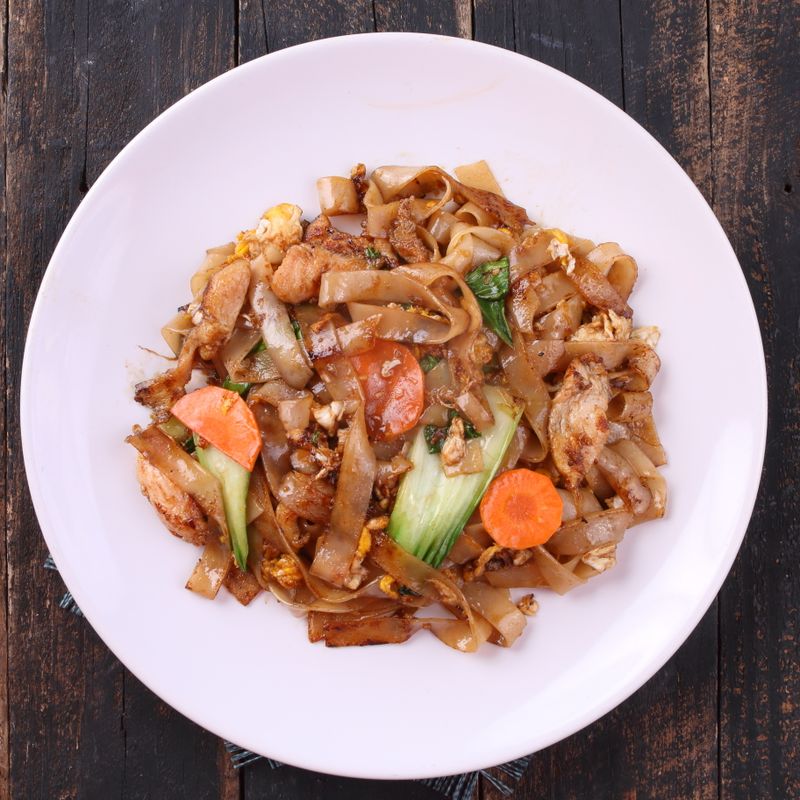
Chicken Pad Thai
Chewy rice noodles and tender chicken are tossed in a sweet-sour-salty tamarind sauce, then finished with scrambled egg, crisp bean sprouts and crunchy peanuts. It takes about an hour and one wok or skillet.
- Prep
- 25 min
- Cook
- 15 min
- Wait
- 30 min
- Total
- 1 hr 10 min
- Makes
- 4 generous servings (about 5 cups total)
Steps
Before you start
- Read the whole recipe first. The stir-frying takes about 12 minutes, so every ingredient must be sliced, measured and next to the stove before you turn on the heat.
- Start the noodle soak first. It takes 30 minutes, and you can slice the chicken, make the sauce and prep the vegetables while it soaks.
- Use dried flat rice noodles about ¼ inch (3 mm) wide, labeled 'pad thai' or 'rice stick'. Don't use fresh noodles or thin vermicelli, because the timing and texture will be different.
- Cook in two batches if your pan is smaller than 12 inches (30 cm). A crowded pan steams the noodles and turns them gummy.
Soak the noodles
- Put the dried rice noodles in a large bowl and cover with very warm tap water, about 110°F (43°C), which should feel hot but not painful.
- Let them soak for 30 minutes, then drain well in a colander.
- Leave them in the colander, and don't rinse them.
+ Show details− Hide details
Ready when: Noodles bend without snapping but are still firm and slightly stiff in the center, like very al dente pasta
Tip: If they are fully soft after soaking, they will fall apart in the wok. Under-soaked is better than over-soaked.
Slice and marinate chicken
- While the noodles soak, toss the chicken strips with the cornstarch and soy sauce in a bowl until every piece is lightly coated.
- Leave at room temperature for 10 minutes while you make the sauce and prep the vegetables.
+ Show details− Hide details
Ready when: Chicken looks evenly coated with no dry cornstarch clumps
Tip: Cut against the grain so the strips stay tender.
Simmer the sauce
- In a small saucepan, combine the tamarind paste, fish sauce, palm sugar, water, rice vinegar and red pepper flakes, if using.
- Set over medium-low heat and stir for 2 to 3 minutes, until the sugar has dissolved and the sauce is smooth and slightly syrupy.
- Remove from the heat and taste.
- It should be a balance of sour, salty and sweet.
- Add a little more sugar if it is too sharp.
+ Show details− Hide details
Ready when: No sugar granules remain and the sauce coats the back of a spoon
Tip: The sauce will taste strong on its own. The noodles will mellow it.
Prep and organize
- Slice the shallots, mince the garlic, cut the scallions, rinse the bean sprouts and chop the peanuts.
- Cut the lime into 4 wedges and beat the eggs in a small bowl.
- Set everything next to the stove in the order you will use it: chicken, shallots and garlic, noodles and sauce, eggs, sprouts and scallions.
+ Show details− Hide details
Ready when: All ingredients are within arm's reach of the stove
Tip: Once the pan is hot, everything moves fast. You won't have time to chop mid-cook.
Sear the chicken
- Heat a 12-inch (30 cm) wok or large nonstick skillet over high heat for 1 minute.
- Add 1 tablespoon (15 ml) of the oil and swirl to coat.
- Add the chicken in a single layer and let it sear undisturbed for 1 minute, then stir-fry for 2 to 3 minutes more.
- Transfer to a clean plate.
+ Show details− Hide details
Ready when: Chicken is opaque white with golden edges and reads 165°F (74°C) in the thickest piece
Tip: If your pan is small, sear the chicken in two batches so it browns instead of steaming.
Soften the aromatics
- Lower the heat to medium-high.
- Add 1 tablespoon (15 ml) of oil, then the shallots.
- Stir-fry for 1 minute until softened and starting to turn golden at the edges.
- Add the garlic and stir for 20 seconds.
+ Show details− Hide details
Ready when: Shallots are translucent and the garlic smells fragrant but is not brown
Tip: Garlic burns fast and turns bitter. Move straight to the next step when it smells fragrant.
Cook noodles in sauce
- Add the drained noodles and pour in the sauce.
- Toss constantly with tongs or a spatula for 2 to 3 minutes.
- The noodles will absorb the sauce and turn glossy.
- If the pan looks dry and the noodles are still firm, add 2 tablespoons (30 ml) of water and keep tossing for another minute.
+ Show details− Hide details
Ready when: Noodles are chewy and tender with no hard center, and little liquid is left in the pan
Tip: Don't leave them untended. Noodles stick quickly once the sauce thickens.
Scramble in the egg
- Push the noodles to one side of the pan.
- Add the last 1 tablespoon (15 ml) of oil to the empty side, then pour in the beaten eggs.
- Let them set for 15 seconds, then scramble into small curds for about 30 seconds.
- Fold the egg into the noodles.
+ Show details− Hide details
Ready when: Egg is fully set with no runny parts, in small pieces among the noodles
Tip: If the egg sticks, scrape the pan as you go.
Finish and combine
- Return the chicken and any juices to the pan.
- Add half of the bean sprouts (1 cup / 75 g) and all of the scallions.
- Toss for 1 minute, just until the sprouts begin to wilt but remain crisp.
- Remove from the heat.
+ Show details− Hide details
Ready when: Chicken is hot throughout (165°F / 74°C), scallions are bright green and sprouts are slightly softened but crunchy
Tip: Taste a noodle. If it needs more salt, add a splash of fish sauce. For more tang, squeeze in a little lime.
Serve right away
- Divide the pad thai among 4 plates.
- Top with the chopped peanuts and the remaining 1 cup (75 g) of raw bean sprouts.
- Serve each plate with a lime wedge to squeeze over the top.
+ Show details− Hide details
Ready when: Noodles are glossy and steaming, with the topping on top
Tip: Pad thai is best hot from the pan. As it cools, the noodles stiffen and absorb the sauce.
Good to know
Tips
- Use a very hot pan and a small amount of food at a time. If noodles clump, your pan is too crowded or too cool.
- Tamarind paste varies a lot in sourness between brands. Taste the sauce before you cook, and adjust with a little sugar or lime.
- Don't over-soak the noodles. They finish cooking in the pan and soak up the sauce as they go.
- Serve with extra lime, chili flakes, sugar and chopped peanuts at the table, so everyone can adjust the flavors.
Make ahead
The sauce keeps in a sealed jar in the fridge for up to 1 week. You can slice the chicken (don't marinate it more than 2 hours ahead), slice the vegetables, and chop the peanuts up to 1 day ahead. Keep each in its own container in the fridge. Soak the noodles on the day you cook.
Storage & reheating
Room temperature: serve within 1 hour and don't leave out longer than 2 hours. Fridge: store leftovers in an airtight container for up to 3 days. Freezer: not recommended, because the noodles turn mushy and the sprouts go limp. Reheat in a skillet over medium heat with 1 to 2 tablespoons of water, tossing for 3 to 4 minutes until steaming hot (165°F / 74°C). Add fresh sprouts and peanuts afterward.
Substitutions
- seedless tamarind paste (soft pulp, not the thin concentrate) → 2 tbsp (30 ml) lime juice plus 1 tbsp (15 ml) rice vinegar plus 1 tbsp (15 g) extra brown sugar. Gives a similar sour note but lacks tamarind's fruity depth. Add the lime juice off the heat.
- boneless, skinless chicken breast → peeled medium shrimp or firm tofu. Shrimp cook in 2 to 3 minutes until pink and curled. Press and cube tofu, then sear it until golden.
- fish sauce → soy sauce, 2½ tbsp (37 ml). Makes the dish less funky and slightly less complex.
- roasted unsalted peanuts → roasted cashews. A nut-free option is toasted pumpkin seeds. Chop them roughly the same size.
More stir-fried noodles
See all →
Find more like this
- Meal
- Dinner
- Cuisine
- Thai
- Main ingredient
- Chicken Breast
- Diet
- Dairy-FreeHalal
- Method
- Stovetop